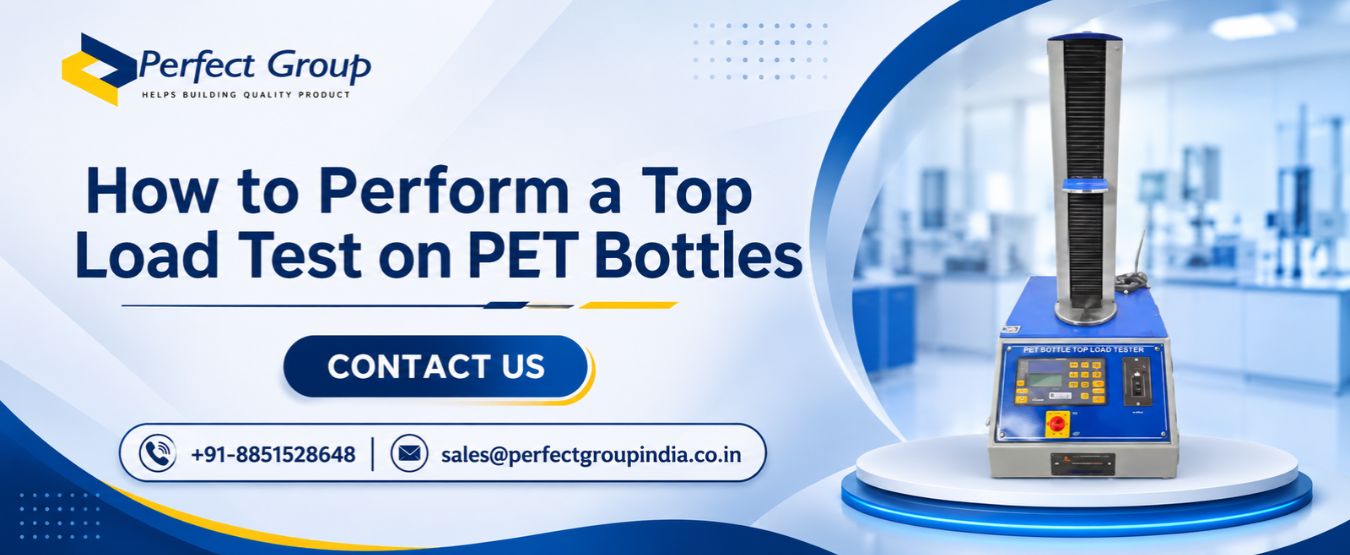
How to Perform a Top Load Test on PET Bottles
Introduction
A Top Load Test on PET Bottles measures how much compressive force a bottle can handle before it deforms, buckles or loses structural stability. PET bottles should be able to handle vertical compressive forces during filling, capping, transportation, stacking and storage.
The Top Load Test on PET Bottles is an important quality control procedure for manufacturers of packaged drinking water, carbonated beverages, edible oils, personal care products and other PET packaging. It helps test bottle strength, maintain packaging similarity and reduce the risk of deformation during handling and distribution.
A Top Load Tester is used to apply controlled vertical compression and measure the force required to produce a specified deformation or cause structural failure.
1. What Is the Purpose of a Top Load Test on PET Bottles?
The purpose of a Top Load Test on PET Bottles is to handle their ability to withstand downward forces without excessive deformation or structural failure.
During manufacturing and distribution, bottles experience compressive loads from:
-
Bottle stacking in warehouses and storage facilities.
-
Conveyor movement and handling during filling operations.
-
Pressure from bottles placed above them during transportation.
-
Capping and packaging operations.
-
Long-term storage under loaded conditions.
A PET bottle compression test helps manufacturers identify weak bottle designs, unstable material distribution and structural defects before products reach the market.
2. Working Principle of a Top Load Tester
A Top Load Testing Machine works by applying a controlled downward force to a bottle placed between two parallel compression plates.
The lower platform supports the bottle while the upper plate moves downwards at a predefined speed. A load cell measures the applied force, while the displacement system tracks changes in bottle height.
The Top Load Tester Working principle is based on recording the relationship between applied compressive force and resulting deformation.
The instrument helps determine:
-
Maximum compressive force before buckling or failure.
-
Force required to reach a specified deformation.
-
Bottle deformation under increasing compression.
-
Consistency of compressive strength across samples.
3. How to Perform a Top Load Test on PET Bottles
Following a continuous testing procedure is important for obtaining repeatable results.
Step 1: Prepare the samples
Select representative bottles from the production batch. Ensure they are clean, dry and free from accidental damage. Record any related details such as bottle weight, dimensions, manufacturing batch and conditioning temperature.
Step 2: Position the bottle
Place the bottle up straight on the lower compression platform. Align its central vertical axis with the centre of the upper compression plate to ensure uniform loading.
Step 3: Configure the tester
Set the required compression speed, force limits and test endpoint according to the selected testing method and product specifications. Verify that the instrument is properly calibrated.
Step 4: Apply compressive force
Start the machine. The upper plate slowly moves downward, applying controlled pressure to the bottle. The load cell continuously measures the applied force.
Step 5: Record the results
Continue testing until the specified deformation, maximum load or structural failure is reached. Record the peak force, corresponding displacement and observed failure behaviour.
Step 6: Repeat the test
Test multiple samples under similar conditions. Compare individual readings and calculate average values to test production stability.
4. How Are Force and Deformation Measured?
During a PET Bottle Compression Test, two important parameters are recorded:
-
Compressive force: The downward force applied to the bottle, generally measured in Newtons (N) or kilogram-force (kgf).
-
Deformation: The change in bottle height or displacement under compression, measured in millimetres (mm).
A load-displacement curve helps identify the bottle's starting resistance, deformation behaviour, buckling point and failure characteristics.
This information helps engineers understand if a bottle can maintain its structural quality under the expected loading conditions.
5. Factors Affecting Top Load Test Results
A Bottle Compression Strength Tester can produce different readings depending on different bottle and testing conditions.
-
Bottle design: Shoulder shape, neck finish, base geometry, ribs and structural reinforcements influence load distribution.
-
Material distribution: Uneven wall thickness can create weak areas that deform under compression.
-
Bottle dimensions: Height, diameter and overall geometry affect vertical stability.
-
Temperature: PET material behaviour changes with temperature, influencing stiffness and deformation.
-
Sample condition: Manufacturing age, handling damage, moisture exposure and conditioning can affect results.
A PET Bottle Buckling Test can help identify weak structural regions that may otherwise remain unnoticed during visual inspection.
Manufacturers can also use a Bottle Thickness Gauge to find differences in wall thickness that may contribute to unstable compression performance.
6. How Manufacturers Interpret Test Results
The results of a Top Load Test on PET Bottles help quality control teams compare bottle performance with internal specifications and customer requirements.
Manufacturers generally test:
-
Average top load resistance across tested samples.
-
Variation between individual bottle readings.
-
Deformation at specified force levels.
-
Buckling location and failure patterns.
-
Performance differences between production batches.
There is no universal acceptable top load value for every PET bottle. Acceptance criteria depend on bottle design, capacity, planned use, filling conditions, stacking requirements and customer specifications.
A Bottle Stacking Strength Test can provide additional insight into packaging performance under storage conditions. However, individual bottle compression testing and actual filled-package stacking analysis are different assessments and should not be treated as interchangeable.
7. Common Testing Errors and How to Avoid Them
Incorrect testing practices can affect the reliability of a Top Load Test on PET Bottles.
-
Misalignment: Centre the bottle between the compression plates to prevent uneven loading.
-
Inconsistent test speed: Maintain the specified compression speed for every sample.
-
Incorrect calibration: Verify the load cell and displacement measurement system regularly.
-
Inconsistent conditioning: Maintain the same temperature and sample preparation conditions.
-
Insufficient sampling: Test representative samples from production batches rather than relying on one bottle.
-
Incorrect sample handling: Avoid testing bottles with accidental dents, scratches or other unintended damage.
For comprehensive PET Bottle Quality Testing, manufacturers should combine compression results with other relevant packaging tests.
Conclusion
A Top Load Test on PET Bottles is an important quality control method for testing bottle strength, deformation behaviour and resistance to vertical compression. Consistent testing helps manufacturers identify structural weaknesses, improve bottle design and maintain packaging quality during filling, transportation and storage.
Perfect Group India offers testing solutions for packaging and plastic manufacturers, including its Top Load Tester, designed to test compressive buckling characteristics of bottles and containers. Manufacturers can explore its PET Bottles and Caps Testing Instruments to support their packaging quality control requirements.