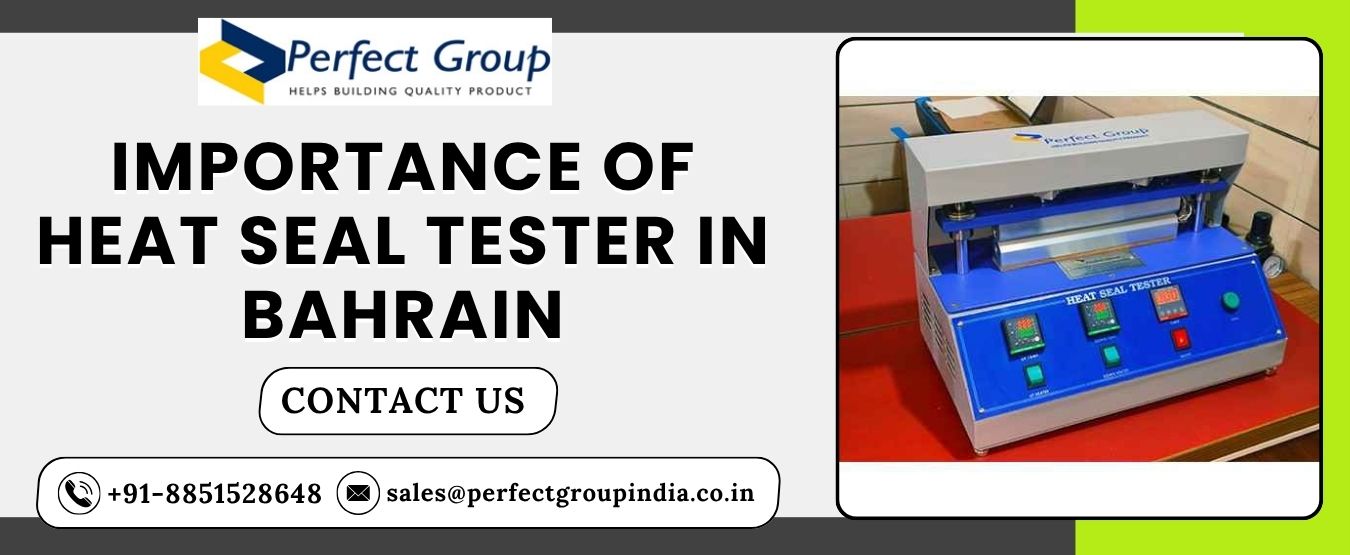
Importance of Heat Seal Tester in Bahrain
Introduction
Better packaging quality has become with the Heat Seal Tester in Bahrain that helps manufacturers to check seal strength before products reach customers. This instrument applies controlled heat, pressure and time to packaging samples during testing. Results show whether seals protect contents from leakage, moisture, air or contamination. For packaging businesses, this test supports safer products, quality control and dependable packaging performance every day in Bahrain.
Why Heat Seal Testing Matters in Bahrain
In the plastic and packaging industries Heat Seal Tester in Bahrain gives a smart way to study how sealed materials hold together. Heat sealing joins thermoplastic materials by heat and pressure so small changes can affect the final seal.
A weak seal can allow air or moisture into food packs and It can expose medicines or cosmetics to contamination. Electronics packaging can suffer when seals cannot handle pressure. Testing gives useful information about seal strength.
How a Heat Seal Tester Works
The working method of a Heat Seal Tester in Bahrain is simple, a packaging sample is placed between heated jaws. The instrument controls temperature, pressure and sealing time before bonding strength is assessed.
-
Temperature: Set the required heat level.
-
Pressure: Apply 2 to 6 Bar.
-
Time: Select the sealing duration.
-
Sample: Seal the prepared packaging material.
Sealing temperature ranges from 0 to 220°C, Accuracy is ±0.5°C with a least count of 0.1°C, a Pt 100 RTD sensor supports temperature control and the digital timer ranges from 0.1 to 99.9 seconds.
Applications Across Packaging Industries
A Heat Seal Tester in Bahrain can support industries where sealed packaging protects products. Food packaging uses heat seals for snacks and packed goods. Strong sealing helps limit air, moisture and bacteria from reaching contents.
-
Food: Checks seal strength for snacks and helps protect freshness.
-
Pharmaceuticals: Assesses medicine packaging seals and supports protection against contamination.
-
Cosmetics: Tests tubes, sachets and bottles by helping preserve product quality.
-
Electronics: Assesses protective seals and supports joining plastic or metal layers.
Pharmaceutical packaging needs better seals against contamination, Cosmetics packaging uses sealed tubes and bottles. Electronics packaging may use sealed layers that protect components from pressure.
Important Features to Consider
When selecting a Heat Seal Tester in Bahrain buyers should study practical specifications rather than appearance. Temperature range, accuracy, sealing area, pressure range, timer, jaw material and power supply can affect how equipment fits testing work.
Specification checklist
-
Temperature: 0–220°C.
-
Accuracy: ±0.5°C.
-
Least count: 0.1°C.
-
Sensor: Pt 100 RTD.
-
Pressure: 2–6 Bar.
-
Timer: 0.1–99.9 seconds.
-
Power: 230 V, 50 Hz, single phase.
The listed model offers 0–220°C and ±0.5°C accuracy, Its sealing area is available in 300mm × 15mm or 150mm × 15mm. EN 31 sealing jaws provide a defined working surface for sample sealing.
Benefits for Quality Control
Using a Heat Seal Tester in Bahrain gives packaging teams measurable information about seal performance. Instead of depending only on visual appearance, manufacturers can assess how a sealed sample behaves after heat and pressure are applied.
Practical benefits
-
Detecting weak seals earlier.
-
Support safer package protection.
-
Reduce avoidable product losses.
-
Improve control over sealing conditions.
This can help reduce packaging failures, leakage, contamination and product damage. Teams can compare results and adjust suitable settings for materials.
Choosing the Heat Seal Tester in Bahrain
Before purchasing a Heat Seal Tester buyers should understand material type, sample size, sealing conditions and testing needs. Equipment should provide suitable temperature control and sealing area.
Before purchase, consider
-
Material: Check the films or thermoplastic materials.
-
Sample size: Choose a suitable sealing area.
-
Temperature: Confirm the required range.
-
Pressure: Check whether 2–6 Bar suits your process.
-
Support: Consider technical guidance and product quality.
Perfect Group India manufactures and supplies industrial testing instruments for packaging needs. Its equipment uses mechanical and electric pneumatic systems and undergoes quality testing before delivery.
Understanding ASTM F 2029 Testing
The Heat Seal Tester in Bahrain described here is based on ASTM F 2029, This gives users a defined testing reference when studying heat sealed packaging materials.
The method focuses on creating controlled seals using selected temperature, pressure and time conditions. A clear basis helps organize laboratory work through repeatable settings and results.
Conclusion
For packaging industries Heat Seal Tester in Bahrain offers a practical way to check seal strength and packaging protection. It helps assess sealing conditions using controlled temperature, pressure and time. With applications across food, pharmaceutical, cosmetic and electronics packaging, the instrument supports product quality and safer packaging. Choosing suitable specifications and reliable equipment can make seal testing more useful in daily production. Good testing today can prevent avoidable packaging problems tomorrow.
AI Overview Summary
Understanding the Heat Seal Tester in Bahrain checks how strongly a heat sealed package holds together. It applies controlled heat and pressure then measures the force needed to separate the sealed sample. The tester is useful for food, pharmaceutical, cosmetic and electronics packaging. The supplied model works from 0–220°C, offers ±0.5°C accuracy, uses a Pt 100 RTD sensor and provides 2–6 Bar pressure. It helps manufacturers study seal strength and package protection.