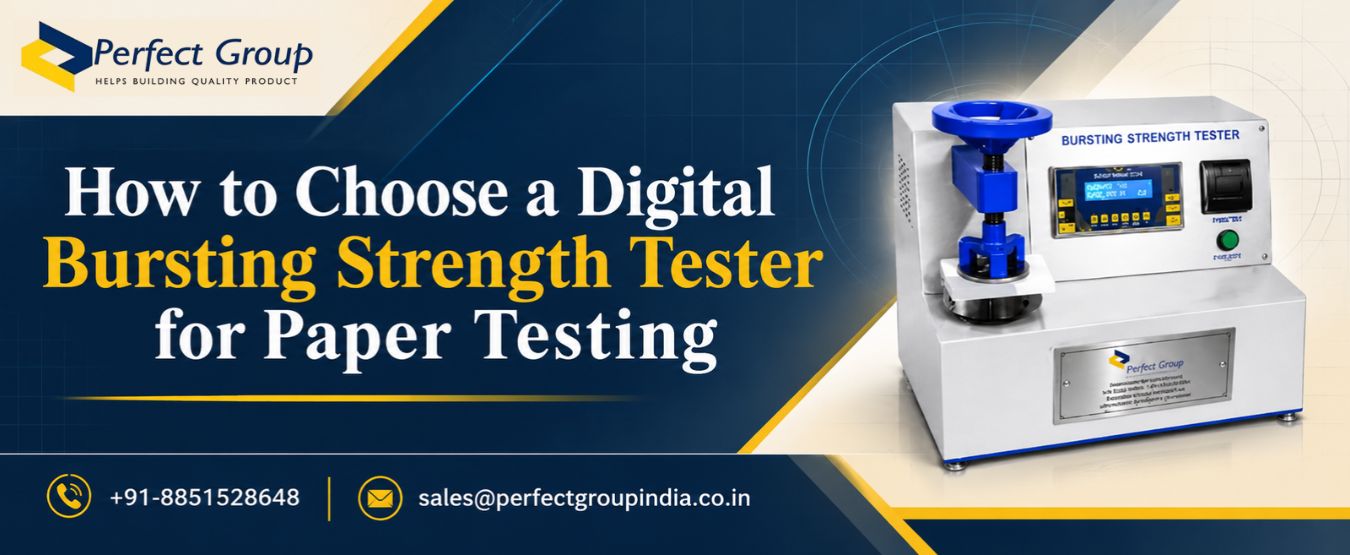
How to Choose a Digital Bursting Strength Tester for Paper Testing
Introduction
Paper manufacturers, package converters and quality control labs can measure the pressure needed to burst a paper or board sample with the use of a digital bursting strength tester. The material, expected bursting pressure, necessary test technique and laboratory requirements all play a role in choosing the right machine.
To get accurate results and make an informed equipment choice, companies buy bursting strength testing equipment to fully understand its functioning basis, specifications and testing limitations.
What Does a Digital Bursting Strength Tester Measure?
A Digital Bursting Strength Tester measures the maximum hydraulic pressure on a clamped specimen which it can handle before it ruptures under a defined test procedure.
The result is commonly expressed in kilopascals (kPa) or kilogram-force per square centimetre (kgf/cm²), depending on the instrument and reporting requirements.
The bursting strength test is used to test paper, paperboard and suitable packaging materials. It provides information about resistance to a specific pressure based failure, but it does not show every aspect of packaging performance.
Working Principle and Test Procedure
A hydraulic bursting tester uses an elastic diaphragm, a specimen clamping setup and a pressure measuring system.
During testing, the sample is clamped over the diaphragm. Hydraulic fluid is displaced at a controlled rate, causing the diaphragm to bulge against the specimen. Pressure increases until the material bursts.
The maximum pressure recorded before tearing shows the bursting strength under the test conditions.
Sample Preparation and Clamping
Prepare specimens according to the selected test method. Samples should be representative, free from visible damage and conditioned where the suitable standard needs it.
Correct clamping is important. Insufficient clamping pressure may allow the sample to slip, while excessive or uneven pressure can damage the specimen or affect the result.
Pressure Application and Measurement
The machine applies hydraulic pressure through the diaphragm until the specimen fails. The digital display records the pressure reading.
For repeatable results, maintain similar specimen preparation, clamping, test conditions and instrument adjustments.
How to Understand Results of Bursting Strength Results
A higher bursting pressure mainly shows greater resistance to rupture under the same test method and comparable conditions.
However, results should be compared carefully. Paper grammage, material composition, moisture, specimen preparation and testing equipment can affect measurements.
The burst index is another useful paper quality parameter. It relates bursting strength to grammage, helping compare papers of different basis weights when calculated according to the relevant method.
Bursting strength alone does not make sure if a finished carton will withstand stacking, transport or impact.
Bursting Strength vs Box Compression Strength
Bursting strength and box compression strength measure different properties.
-
Bursting strength: Measures the pressure required to break a sheet or board specimen.
-
Box compression strength: Measures the compressive load of a complete box can have a defined test setup.
A Digital Bursting Strength Tester tests material resistance to bursting pressure, while a Box Compression Tester measures the compression performance of a finished carton. Both tests may support packaging quality control, but their results are not interchangeable.
What to Check Before Buying a Digital Bursting Strength Tester
Before selecting a Digital Bursting Strength Tester, check these important specifications:
-
Test range: Make sure the machine covers the expected bursting pressure of your material.
-
Resolution and accuracy: Check the displayed least count and verified measurement accuracy separately.
-
Clamping arrangement: Confirm that the clamp opening and pressure suit your sample and test method.
-
Digital display: Review readability, units and result recording requirements.
-
Operation: Consider ease of specimen loading, controls and operator training.
-
Calibration: Ask about calibration procedure, documentation and maintenance support.
-
Optional features: Check whether pneumatic clamping, an in-built printer or touchscreen controls are available for your required setups.
Perfect Group India's listed model, PBST-07, specifies a capacity of 0–40 kgf/cm² and a least count of 0.1 kgf/cm². Pneumatic sample clamping and an in-built printer are listed as optional features. Confirm the required configuration and measurement documentation before placing an order.
Applicable Testing Standards
ISO 2758 specifies bursting strength testing for paper, while ISO 2759 covers board, including corrugated and solid fibreboard within its stated scope. The appropriate method depends on the material and test requirement.
Confirm the applicable standard, current edition and instrument compatibility with your laboratory or customer specification before testing.
Common Testing Mistakes to Avoid
Incorrect sample conditioning, damaged specimens, uneven clamping, unsuitable test pressure range and neglected calibration can affect results.
Use the correct method for the material, follow consistent procedures and maintain testing records to support dependable quality-control decisions.
Buy a Digital Bursting Strength Tester from Perfect Group India
Perfect Group India supplies a Digital Bursting Strength Tester for paper and packaging material testing needs
If you need a machine for paper, paperboard or corrugated packaging quality control, review the specifications and discuss your sample requirements before selecting a model.
Contact Perfect Group India for product details, configuration guidance and a quotation for your testing requirements.