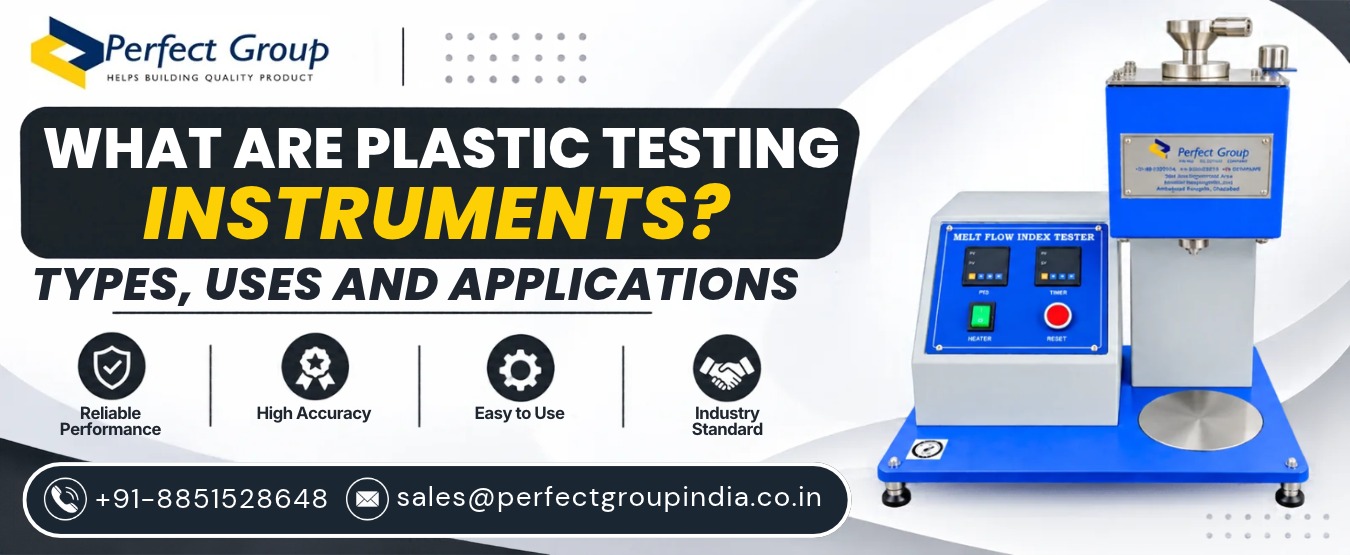
What Are Plastic Testing Instruments? Types, Uses and Applications
Types of Plastic Testing Instruments are laboratory instruments and equipment that are used to test the physical, mechanical and processing properties of plastic materials. These tools help manufacturers to measure impact resistance, tensile strength, melt flow behaviour, moisture content and environmental stress cracking resistant properties. Choosing suitable plastic testing equipment helps quality control, material selection and stable manufacturing.
What Are Plastic Testing Instruments?
Plastic testing instruments are highly specialised machines that examine how plastic materials perform under different testing situations. They help laboratories and manufacturers in deciding if raw materials, polymer samples and final plastic components fulfil needed quality standards.
Depending on the property being tested, Plastic Testing Machines can measure tensile strength, impact resistance, melt flow rate and moisture content. You can explore the available Plastic Testing Instruments at Perfect Group to understand the equipment used for different laboratory testing requirements.
What Are the Different Types of Plastic Testing Equipment?
The different types of plastic testing equipment are categorized according to the material property or performance characteristic they measure.
1. Impact Testing Instruments
Impact testing instruments measure how much energy a plastic specimen can absorb before breaking when put into a sudden force. They help manufacturers understand the impact resistance and toughness of plastic materials.
Common equipment includes:
These machines are useful when testing plastic components that may experience sudden impacts during handling, transportation or regular use.
2. Melt Flow Index Testing Instruments
Melt flow testing equipment measures how easily a thermoplastic material flows when heated under a specified load. The result helps compare polymer flow behaviour and check material suitability for processing.
A Melt Flow Index Tester is commonly used in plastic manufacturing laboratories for raw material inspection, material comparison and process quality control. Perfect Group also offers a Computerized Melt Flow Index Tester.
3. Tensile Strength Testing Instruments
Tensile testing shows how a plastic specimen performs when a pulling force is applied. It helps in understanding qualities such as tensile strength and length, depending on the test technique and equipment design.
A Digital Tensile Strength Tester can support quality checks for suitable plastic specimens. These results help manufacturers compare material performance and identify diffrences.
4. Moisture Testing Instruments
Moisture testing instruments measure the moisture present in plastic raw materials. Excess moisture in certain polymers can create processing defects, including surface imperfections, bubbles or unstable product quality.
A Digital Moisture Analyzer/Balance helps laboratories check moisture content before materials enter production. This is mainly useful for plastic granules and other moisture sensitive raw materials.
5. Environmental Stress Cracking Resistance Testing Equipment
Environmental stress cracking resistance testing defines how a plastic material responds when mechanical stress and exposure to a particular chemical environment act together.
An E.S.C.R. Test Apparatus is used for this specialised testing. The test can help find the resistance of selected plastic materials to stress cracking under set conditions.
6. Notch Cutters for Impact Test Specimen Preparation
Notch cutters are used to prepare plastic specimens with a controlled notch before certain impact tests. The notch creates a defined stress concentration, helping laboratories conduct more stable impact tests.
Perfect Group lists both a Hand-Operated Notch Cutter and a Motorised Notch Cutter. These are specimen preparation devices rather than instruments that independently measure a material property.
Which Instruments Are Used for Plastic Material Testing?
The instruments depend on the property being examined. Impact testers find impact resistance, tensile testers measure the response to pulling forces, melt flow index testers measure polymer flow, moisture analyzers measure moisture content and ESCR apparatus tests resistance to environmental stress cracking.
Therefore, Plastic Material Testing generally needs more than one test when a manufacturer needs to understand different performance characteristics. The suitable combination depends on the polymer type, product use and suitable test procedure.
Why Is Plastic Material Testing Important?
Plastic material testing is important because product performance depends on material properties and manufacturing conditions. Testing helps businesses:
-
Maintain product quality: Identify differences in raw materials and finished products.
-
Measure mechanical performance: Understand strength, length and impact behaviour.
-
Improve processing control: Compare melt flow and moisture characteristics before production.
-
Support material selection: Choose suitable polymers for specific needs.
-
Reduce production defects: Detect potential material-related issues during quality checks.
-
Maintain consistency: Use defined test procedures to compare batches and samples.
Using the right Plastic Testing Methods helps manufacturers make informed decisions instead of depending just only on visual inspection.
Which Industries Use Plastic Testing Machines?
Plastic testing machines are related to industries that manufacture, process or use polymer-based products. These include plastic processing and moulding, packaging, automotive components, electrical products, consumer goods and polymer material development.
The specific testing requirements change based on usage. For example, a manufacturer producing impact-sensitive components may prioritise impact testing, while a polymer processor may focus on melt flow characteristics and raw material consistency.
How Do You Select the Right Plastic Testing Instruments?
Before selecting Plastic Testing Instruments, consider the following factors:
-
Material type: Identify the polymer or plastic material being tested.
-
Testing requirement: Decide if you need impact, tensile, melt flow, moisture or ESCR testing.
-
Test method: Check the suitable standard and specimen requirements for your use.
-
Instrument configuration: Review capacity, operating range, controls and measurement requirements.
-
Laboratory needs: Consider testing frequency, available space, operator requirements and maintenance support.
Choosing Plastic Quality Testing Equipment based on the actual testing objective helps laboratories obtain useful and consistent results.
Explore Plastic Testing Instruments at Perfect Group
Perfect Group offers a range of Plastic Testing Instruments for laboratory testing and industrial quality control. Its listed range includes impact testers, melt flow index testers, a digital tensile strength tester, a digital moisture analyzer, an ESCR test apparatus and notch cutters for specimen preparation.
Explore the complete Plastic Testing Instruments range to review available equipment. For assistance in identifying suitable laboratory equipment, contact Perfect Group with your material testing requirements.