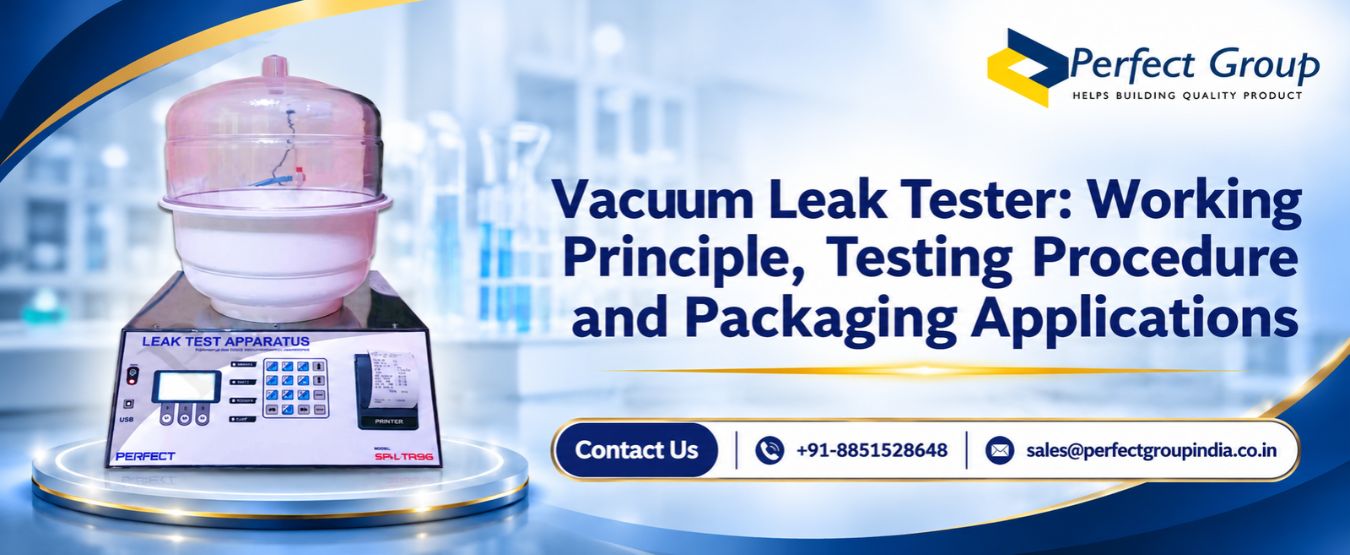
Vacuum Leak Tester: Working Principle, Testing Procedure and Packaging Applications
Introduction
A vacuum leak tester helps manufacturers measure packaging quality by finding leakage paths that can compromise product protection, shelf life and sealing quality. In food, pharmaceutical, cosmetics and packaging industries, even a small defect in a sealed package can allow air or bacteria to enter. A properly selected vacuum leak testing machine helps quality control teams check package performance under controlled vacuum conditions. From PET bottles and rigid containers to flexible pouches and sachets, vacuum leak testing provides a practical way to find packaging defects before products reach the market.
How Does a Vacuum Leak Tester Work?
A vacuum leak tester works by creating a controlled negative-pressure environment around or inside a test package, depending on the testing method.
In a common wet-testing setting, the sample is placed inside a transparent chamber containing water. When vacuum is applied, air escaping through a leakage point produces visible bubbles. A continuous stream of bubbles can show a leakage path, while isolated bubbles may simply be trapped air.
In a dry vacuum decay method, the test package is placed inside an evacuated chamber and pressure changes are monitored using pressure measuring sensors. A pressure rise beyond the specified acceptance limit shows a possible leak.
The vacuum leak detector therefore helps identify packaging defects that may not be visible during routine visual inspection.
Vacuum Leak Testing Procedure: Step-by-Step
A continuous vacuum leak test procedure is important for getting repeatable quality control results.
-
Prepare the sample: Select representative packaging samples and inspect their seals, closures and surfaces.
-
Position the sample: Place the package inside the suitable testing chamber. For wet testing, ensure the sample is properly submerged.
-
Set testing parameters: Select the required vacuum level and holding duration according to the packaging material and validated test procedure.
-
Apply vacuum: Operate the vacuum system to create the required pressure differential.
-
Observe the sample: In bubble-emission testing, look for a continuous stream of bubbles showing leakage.
-
Release vacuum: Return the chamber to atmospheric pressure before safely removing the sample.
-
Record results: Document leakage observations, test conditions and sample acceptance or rejection.
The test procedure should be used across samples. Vacuum level, exposure time, package condition and sample preparation can affect the results.
Wet vs Dry Vacuum Leak Tester: Understanding the Difference
A wet vacuum leak tester and a dry vacuum leak tester use different detection principles.
Wet vacuum leak testing finds escaping air through visible bubble formation when a package is dipped in liquid. ASTM D3078 describes a bubble-emission method for detecting gross leaks in flexible packaging containing headspace gas. However, this method may not detect very small leaks, and its suitability depends on the package structure and test conditions.
Dry vacuum leak testing can use the vacuum decay principle. Under ASTM F2338, leakage is calculated by measuring pressure rise inside an evacuated test chamber. It is a non-destructive method that does not require introducing water or dye into the package.
A packaging vacuum decay tester is especially related when non-destructive testing and measurable pressure changes are required.
These methods should not be treated as interchangeable. The right vacuum seal tester depends on the package design, material, product contents and required detection sensitivity.
Applications of Vacuum Leak Testing in Packaging
A vacuum leak tester is used across several industries where packaging quality affects product quality.
-
PET bottles and plastic containers: Vacuum leak test for PET bottles and other containers helps test closure quality and leakage paths.
-
Flexible packaging: Pouches, sachets and heat-sealed bags can be checked for gross leakage using suitable bubble-emission methods.
-
Food packaging: Helps check sealed food packs and packaging used for storage and transportation.
-
Pharmaceutical packaging: Supports quality tests of suitable blister packs, trays, bottles and sealed containers.
-
Cosmetic packaging: Helps check jars, bottles and other packaging formats where leakage can cause product loss.
-
Industrial packaging: Supports testing of selected containers used for chemicals and other industrial products.
A vacuum leak tester for containers or bottles must be selected according to sample dimensions, material behaviour and the suitable test method.
Vacuum Leak Tester: Important Selection Factors
Before purchasing vacuum testing equipment, manufacturers should make sure:
-
Vacuum range: The available range should suit the packaging material and test requirements.
-
Chamber dimensions: The chamber must fit the actual sample size and shape.
-
Pressure measurement: Check the gauge type, measurement resolution and adjustment requirements.
-
Timer settings: Controlled holding time supports repeatable testing.
-
Vacuum generation: Test the vacuum pump and its suitability for the required operating conditions.
-
Test method: Confirm whether the equipment supports the required wet-testing or dry-testing needs.
-
Documentation: Check adjustment, operating instructions and applicable test-method requirements.
A vacuum testing machine should be selected based on actual quality control needs rather than specifications alone.
Conclusion
A vacuum leak tester plays an important role in packaging quality control by helping manufacturers identify leakage problems before distribution. Understanding the vacuum leak test procedure, working principle and differences between wet and dry testing makes equipment selection more effective. Whether testing PET bottles, rigid containers, flexible pouches or other packaging formats, the correct testing method must match the sample and required detection capability.
Looking for reliable packaging testing solutions?
Perfect Group India offers industrial testing instruments for manufacturers seeking better quality test and packaging performance analysis. If you are planning to purchase a vacuum leak tester, contact Perfect Group India to discuss your sample type, testing requirements, chamber specifications and suitable equipment setup. Our team can help you identify a suitable testing solution for your quality control use.
Visit the Contact Us page to discuss your requirements and request product details.