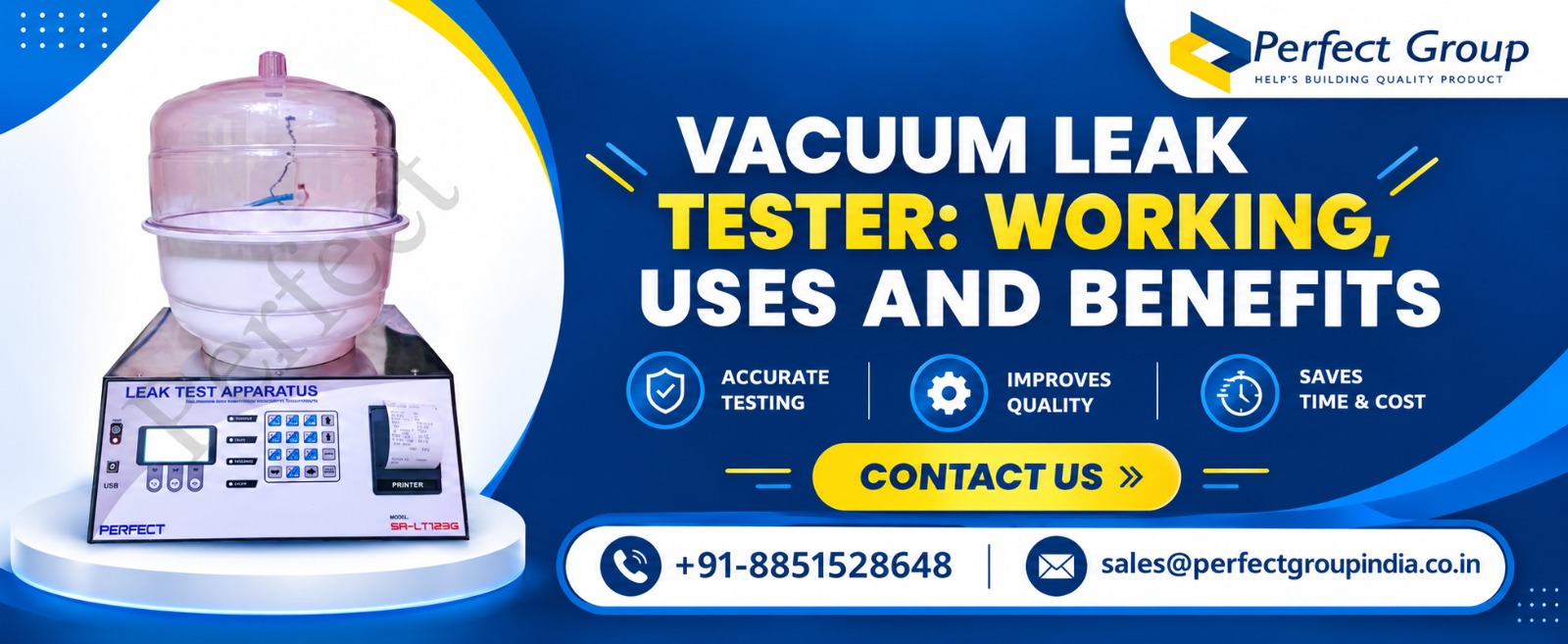
Vacuum Leak Tester: Working, Uses and Benefits
Introduction
A reliable Vacuum Leak Tester helps manufacturers to find hidden leaks in sealed packs before defects cause contamination, spoilage, returns or product loss. It creates vacuum and observes pressure changes that can indicate leakage. ASTM F2338 recognizes vacuum leak as a non-destructive leak method for rigid, semi rigid and flexible packages. This guide covers products, specifications, benefits and buying.
You will learn vacuum leak, chamber size, display, printing and touch screen controls. Perfect Group India supplies packaging testing equipment for industries important procedures.
What Is a Vacuum Leak Tester?
A Vacuum Leak Tester places a sealed sample inside a chamber and creates controlled vacuum around the package. If leakage exists, gas can escape and cause pressure changes that the instrument can detect. ASTM F2338 describes this pressure change principle for non-destructive vacuum leak testing.
The package stays closed, the tester compares pressure response with the selected limit.
How Does a Vacuum Leak Tester Work?
-
Place the sealed sample inside the chamber and close the lid.
-
Start the vacuum cycle until the selected pressure level is reached.
-
Hold pressure for the required time and observe its response.
-
Compare the measured change with the selected acceptance limit.
-
Record the sample as accepted or rejected according to your procedure.
ASTM F2338 explains that acceptance criteria can use baseline measurements from non leaking control packages.
What Can a Vacuum Leak Tester Detect?
A Vacuum Decay Tester can detect sealed packaging formats when the package and method suit vacuum leak testing. ASTM F2338 includes rigid, semi rigid, flexible and nonporous package types.
Common test items include:
-
Plastic bottles and sealed containers
-
Flexible pouches and packs
-
Blisters and pharmaceutical strips
-
Foiled cups and sealed trays
-
Cans and selected rigid packages
-
Pill boxes and similar pharmaceutical packs
The method depends on package material, contents and sensitivity, ASTM also lists separate methods for flexible packaging and empty rigid containers.
Key Specifications of Vacuum Leak Tester
Buyers comparing a Vacuum Leak Tester should compare vacuum range, chamber size, timer, display, reporting and power.
-
Vacuum level: The supplied model provides 50–650 mm Hg at MSL for vacuum testing.
-
Timer: The standard timer covers 0–999 seconds with other timing requirements available on customer request.
-
Display: A digital LCD readout presents test information clearly during operation.
-
Chamber: Polycarbonate chambers are available in 150, 200 and 300 mm diameter sizes.
-
Printer: An inbuilt printer is available as an optional feature for test reports.
-
Power: The equipment uses a 220V AC, 50Hz power supply.
-
Touch screen: A touch screen version provides clear controls and easier viewing of test information.
Why Is Vacuum Leak Testing Important?
A sealed package can look normal and still contain a small leak at its seal or wall. Such defects can allow unwanted gases to enter. ASTM notes that package leaks can affect food, pharmaceutical and medical device packaging.
Vacuum testing helps find hidden leakage without opening or damaging the tested package. ASTM describes vacuum leak as rapid, non-invasive and non-destructive when used correctly.
Leak testing can identify defects before products continue through production. This makes the method useful when sealed packages need repeatable internal quality testing.
Main Benefits of Vacuum Leak Tester
The Vacuum Tester helps manufacturers assess sealed packaging and identify possible defects.
-
Non destructive testing can preserve the tested sample.
-
Vacuum leak can reveal leaks not easily visible.
-
Digital readings make information easier to follow.
-
Adjustable timing supports different product requirements.
-
Optional printing helps maintain physical test records.
-
Different chamber sizes support varied sample dimensions.
ASTM F2338 also describes vacuum decay for research, comparisons, production testing and sampling.
Who Should Use Vacuum Leak Testing?
A Tester can help food and beverage manufacturers study sealed packaging and find defects that can affect package integrity. Pharmaceutical manufacturers can use suitable methods where seal quality matters.
Packaging manufacturers can use it during product development and production quality work. Electronics makers can also need sealed package testing where protection from air or moisture matters.
Research teams can use vacuum decay when comparing package materials or package designs. ASTM recognizes its use for research and comparative evaluation. Perfect Group India supports buyers seeking packaging testing equipment.
How to Choose the Right Vacuum Leak Tester?
Start by identifying package type, dimensions, contents, expected leakage and test time. Then compare these needs with chamber size and vacuum range.
Also consider digital readings, printed reports or touch screen controls. The method should match your internal procedure and relevant packaging standard. ASTM explains that sensitivity depends on sensor capability, package design, pressure and test time.
Before ordering, share samples and discuss acceptance limits. Perfect Group India can also review suitable test needs.
Conclusion
In conclusion, a Vacuum Leak Tester helps to evaluate sealed packages without opening samples or depending on visual examination. Vacuum leak creates controlled vacuum conditions and observes pressure changes that reveal leakage. ASTM recognizes this as a non-destructive leak detection method with limits established for the tested package.
The right choice depends on sample type, chamber size, vacuum range, test time and sensitivity. Perfect Group India offers packaging testing equipment and packaging test support, so buyers can discuss samples and select a setup. And also Perfect Group India can help buyers discuss suitable equipment. A tester can support tests and better quality decisions.