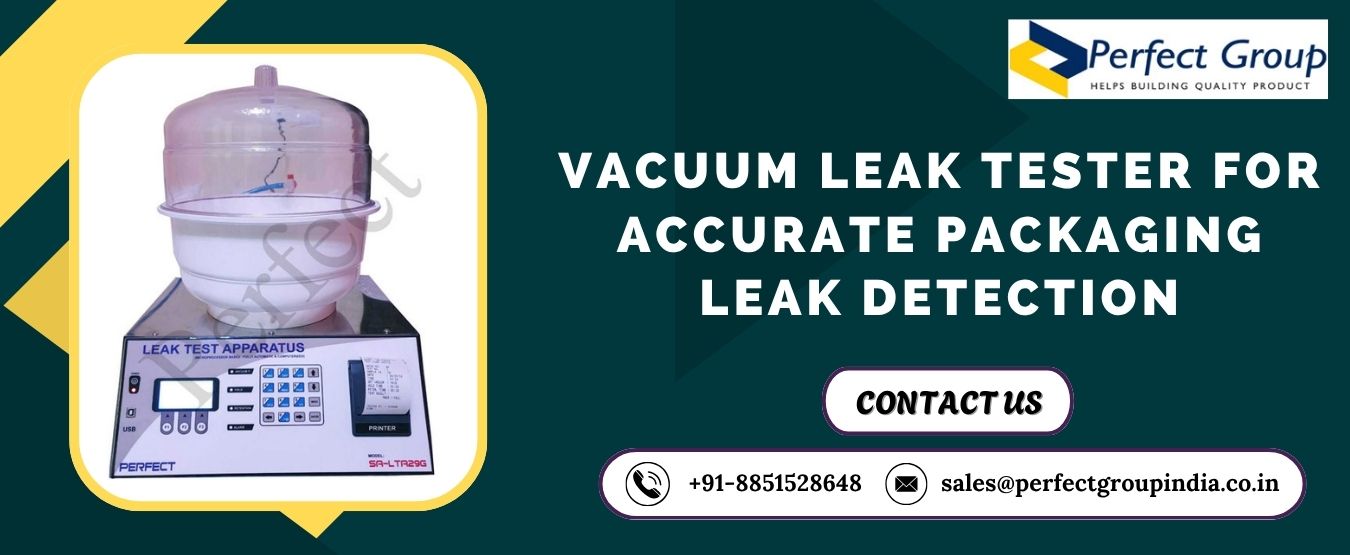
Vacuum Leak Tester For Accurate Packaging Leak Detection
Introduction
By creating a controlled vacuum around a test package and recording how it reacts, a Vacuum Leak Tester helps in finding leaks or loss of package quality. It is helpful for finding seal failures, pinholes, cracks and other defects that could let products, pollutants, moisture or leaks. Controlled leak testing is a useful quality test that goes beyond regular visual checks for the food, pharmaceutical, FMCG, flexible packaging and changing industries.
What Is a Vacuum Leak Tester?
A Vacuum Leak Tester is a piece of equipment used in labs for quality control to check a package's strength under carefully controlled conditions. A sample is placed within a chamber that is the right size, the chamber is sealed, a vacuum is formed and the package result is examined using specified approval standards.
The basic process involves:
-
Placing the specimen inside the chamber.
-
Sealing the chamber correctly.
-
Applying the required vacuum.
-
Maintaining the specified test duration.
-
Observing or recording the response.
-
Comparing the result with the applicable acceptance criteria.
The package and test technique control the vacuum level, stay time and analysis.
Why Is Vacuum Leak Testing Important for Packaging?
Vacuum leak testing helps in finding packing defects before they become issues with product quality or customer service. Poor heat seals, tiny holes, seal-channel defects, cracks, weak closures, material breakdown and uneven sealing can all be found with it.
When packaging needs to protect goods from damage, moisture, air leakage, leaks or exposure to the environment, this method is important. Food, pharmaceutical, FMCG, flexible packaging, pouches, sachets, laminated films, plastic packaging and other suitable containers are some of the possible uses.
How Does a Vacuum Leak Tester Work?
A controlled pressure difference is created around the test package using a Vacuum Leak Tester. Defects that are hard to find during visual inspection can become clear as a result.
The operator sets up the chamber, places the sample, seals it, applies the necessary vacuum, keeps the conditions under control and measures the package responses. Instead of replacing every testing method, vacuum testing can be used in combination with other package strength testing techniques.
What Types of Packaging Can Be Tested?
The size of the chamber, the design of the instrument, the materials of the package and the proper testing method all impact the right packaging. Common uses are as follows:
-
Flexible pouches and bags
-
Sachets
-
Laminated films
-
Plastic packaging
-
Suitable containers
-
Sealed packaging assemblies
Check sample dimensions, chamber capacity, package flexibility and testing needs before making a purchase.
What Does Vacuum Leak Testing Detect?
The main purpose of a Vacuum Leak Tester is to find out if a package shows signs of leaking or damaged safety under specific conditions. Seal leakage, pinholes, visible micro leaks, cracks, poor seals and package damage can all be found with its help.
The device, test method, package design, defect features and chosen vacuum conditions all affect detection capabilities.
How Does Vacuum Leak Testing Improve Quality Control?
The incoming packaging testing, seal checking, batch comparison, finished package inspection, supplier quality checks, process problem resolution, packaging development and leakage complaint investigation are all supported by vacuum testing.
Packaging risk, production volume, process stability, customer requirements, legal standards and internal quality procedures should all be taken into consideration when selecting the duration of testing.
How Is a Vacuum Leak Test Performed?
Choosing suitable samples, looking for visible damage, properly arranging the sample, sealing the chamber, applying the required conditions, keeping track of the response and comparing the results with accepted guidelines are all common steps in the process.
Reliable batch comparisons need compatible sample preparation, proper placement, vacuum conditions, storage time and testing procedures.
What Factors Affect Vacuum Leak Test Results?
Results can be affected by:
-
Package material and geometry
-
Seal construction and seal width
-
Defect characteristics
-
Vacuum level and test duration
-
Temperature
-
Sample positioning
-
Chamber condition
-
Instrument condition
-
Operator technique
How Do You Choose a Vacuum Leak Tester?
Select equipment according to the type of package, a suitable test technique, the size of the chamber, the dimensions of the sample, vacuum control, testing volume, measurement capability, stability and reporting needs.
Digital operation, customisable settings, data storage, support for rechecking or verification, maintenance, spare parts, operator training and technical service should all be kept in mind. Instead of being the only basis for selection, the cost of a Vacuum Leak Tester should be looked at in balance with these technical specifications.
Why Choose Perfect Group India as a Vacuum Leak Tester Manufacturer and Supplier?
For packaging and material testing needs, Perfect Group India produces and supplies laboratory and quality control testing equipment. Customers can analyse its equipment based on the type of packaging, testing method, laboratory requirements and technical support requirements.
Usage advice, equipment suitability, maintenance support, verification guidance and after sales technical support are all important factors to think seriously when selecting a Vacuum Leak Tester manufacturer and supplier.
What Features Should You Compare Before Buying?
Compare:
-
Vacuum control
-
Chamber dimensions
-
Sample capacity
-
Measurement capability
-
Digital display
-
Automatic operation where applicable
-
Test-duration control
-
Result recording and data storage
-
Chamber construction
-
Cleaning requirements
-
Verification or calibration support
-
Service and spare-parts availability
How Should a Vacuum Leak Tester Be Maintained?
Maintain the chamber's hygiene and check the vacuum connection, pipes, fittings and seals. Follow the manufacturer's maintenance guidelines and if necessary, keep test results or verification records.
Damaged parts should be changed as necessary and operators should receive the right training. Reducing delay and maintaining stable test conditions are two benefits of proper maintenance.
Conclusion
Effective leak detection protects packaging quality while reducing the risk of leakage, product loss and customer complaints. A Vacuum Leak Tester offers a controlled method for analysing correct packages under specific vacuum conditions.
Before making a purchase, analyse the package type, test technique, vacuum conditions, chamber size, test capacity, inspection conditions, repeatability, verification needs, maintenance and technical support. Perfect Group India can be rated based on these technical and service factors.