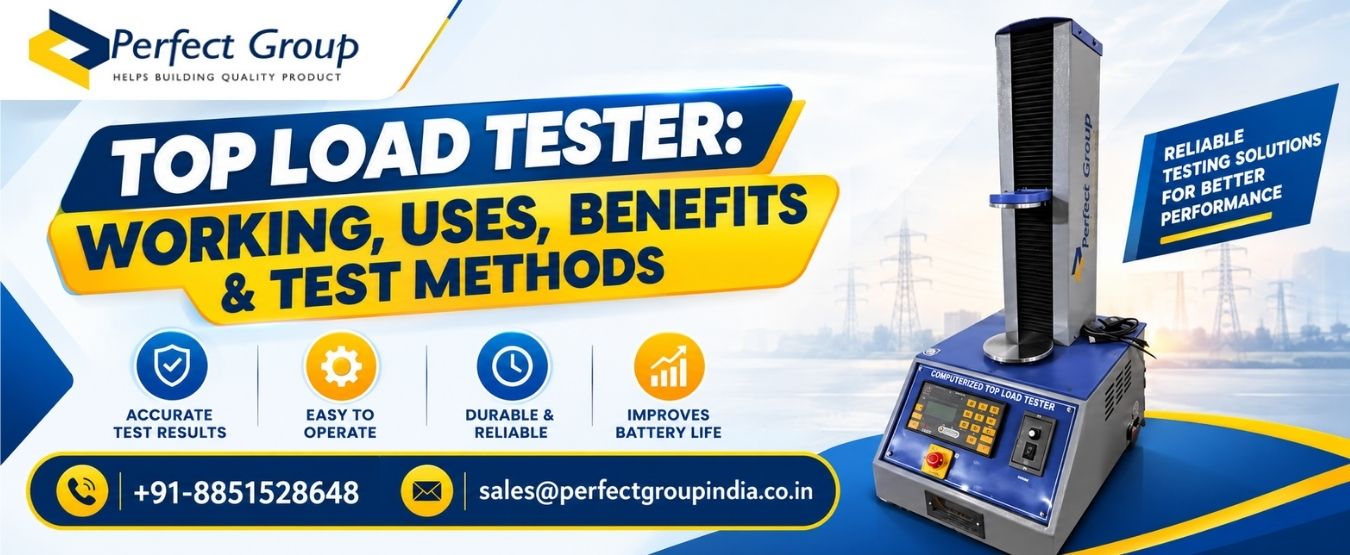
Top Load Tester: Working, Uses, Benefits & Test Methods
Introduction
Packaging manufacturers depend on a Top Load Tester to see how much vertical force a bottle or container can handle before it bends or collapses. This simple compression test gives data for comparing container designs, materials, wall thickness and production samples. It works well for bottles, jars and other containers that face pressure during filling, storage, stacking and transport. In this guide I explain the working process, tested products, common test methods, benefits, standards and specifications that buyers should compare.
What Is a Top Load Tester?
The compression force applied to a container until it buckles, collapses or deforms is measured with a Top Load Tester. The sample is placed between two compression plates, pressure is applied from the top in a controlled way. A force sensor tracks the load as the test happens. This gives a peak force value. The value is compared to a required specification or to a reference sample.
Main parts include:
-
Load sensor: Records the force applied to the sample.
-
Upper platen: Applies downward pressure.
-
Test platform: Holds the sample upright.
-
Digital display: Shows force readings.
-
Speed control: Sets the compression rate.
How Does Top Load Testing Work?
During a Top Load Tester the container is set in the center of the platform then the upper plate moves down slowly. The machine pushes with a force that matches a chosen speed. A sensor tracks how load the container takes as it reacts. The test goes on until the container reaches a force or bends past a set point or breaks completely.
-
Place the sample in a position and make sure it lines up with the plates.
-
Set the speed and test limits according to the method that has been chosen.
-
Push down with force using the upper platen.
-
Write down the load, how much it deforms and the highest force recorded.
-
Check the results against the needed specification and compare them to the reference sample.
The basic principle is simple: controlled pressure comes from the top and the instrument records how the container responds as force increases.
What Does a Top Load Tester Measure?
The primary function of a Top Load Tester is to measure force and identify the load at which a container starts to break or deform. The measurement can also display how deformation changes as force increases providing more useful data than a single final figure.
Common readings include:
-
Maximum load: Highest force reached before failure or stopping.
-
Deformation: Change in container shape during compression.
-
Peak force: Highest force recorded during one test.
-
Force curve: Shows load changes through the test.
-
Sample variation: Helps compare different production samples.
ASTM D2659 looks at how blown thermoplastic containers crushed when a column is pressed is useful if your test goal is the same as this standard.
Which Products Can Be Tested?
Packaging manufacturers can use a Top Load Tester to test bottles, jars, drums, trays, boxes and other suitable containers. The fixture, sample size, load range and method should match the product being tested.
Common samples include:
-
PET bottles used for beverages and packaged goods.
-
Plastic jars exposed to vertical pressure.
-
Glass containers requiring vertical load testing.
-
Drums and larger containers facing stacking pressure.
-
Packaging units where compression strength matters.
Perfect Group India offers testing instruments for packaging and material testing. The PTLT-07 model as described in its published details has a capacity of 100 kg. The instrument provides readability of 0.01 kg and accuracy of ±0.05% and includes a peak hold function and supports speed operation from 15 mm/minute to 150 mm/minute.
What Are the Main Benefits?
A Top Load Tester gives manufacturers measured data instead of depending only on visual judgement. Results can help compare bottle shapes, material thickness and production changes before a packaging design is finalized.
-
Design comparison: Compare shapes or thicknesses using measured force.
-
Damage reduction: Find weak designs before filling or transport.
-
Material savings: Support lighter packaging when strength remains suitable.
-
Batch comparison: Identify changes between production samples.
-
Record keeping: Digital systems can save readings and reports.
Perfect Group India also offers equipment for paper, plastic, PET bottle and packaging tests, allowing manufacturers to use different instruments for different test needs.
Which Test Methods Are Common?
Different Top Load Tester methods are selected according to the sample and the question being studied. A peak load test focuses on maximum force, whereas a fixed load test observes the sample under a chosen force.
-
Peak test: Records the highest compression force reached.
-
Fixed load test: Applies a selected force and records the response.
-
Fixed deformation test: Records force at a chosen deformation.
-
Single compression: Applies one controlled compression cycle.
-
Cyclic compression: Repeats loading cycles to study repeated pressure.
Common packaging references include ASTM D2659, ASTM D4577, ASTM D642, ASTM D4169 and ISO 8113. The correct packaging references vary with the container and the intended test condition.
What Specifications Should Buyers Compare?
When selecting a Top Load Tester, compare load capacity, readability, accuracy, sample dimensions, speed range and data recording features. Capacity should suit the expected force without making the working range unsuitable for smaller samples.
For the Perfect Group India PTLT-07, published specifications include 100 kg capacity, 0.01 kg readability, ±0.05% accuracy, peak hold locking and 15–150 mm/minute variable speed. Bottle height and base size can be arranged according to sample requirements.
Why Are Standards Important?
A test standard explains how a particular compression test should be performed and what sample or condition it covers. This matters because different speeds, loads and sample arrangements can produce different results.
ASTM D4577 covers compression resistance of containers under constant load, ASTM D642 covers shipping container compression and ISO 8113 covers vertical load resistance for glass containers. The chosen method should match the product.
Perfect Group India can support equipment selection according to sample needs and measurement range. The final method should follow the applicable standard or customer specification.
How Should Test Results Be Read?
A high peak force does not describe every part of container performance. The force and deformation curve can show whether the sample gradually bends, suddenly buckles or fails after reaching a high load.
A sudden force drop may indicate collapse, whereas gradual deformation can show progressive loss of shape. Comparing several samples can reveal changes linked to bottle design, wall thickness, mould changes or production conditions.
Conclusion
For packaging manufacturers a Top Load Tester is an instrument to check how much vertical pressure bottles, jars, drums and other packaging can handle. The test can show the force, how the package changes shape and how different samples compare. It is important to pick the size, speed, attachments and rules because every product needs a different way of testing. Perfect Group India has the PTLT-07 which has details about how it works for testing the strength of containers. The best results happen when the tool and the method match the item being tested, the force expected and the rules that apply.