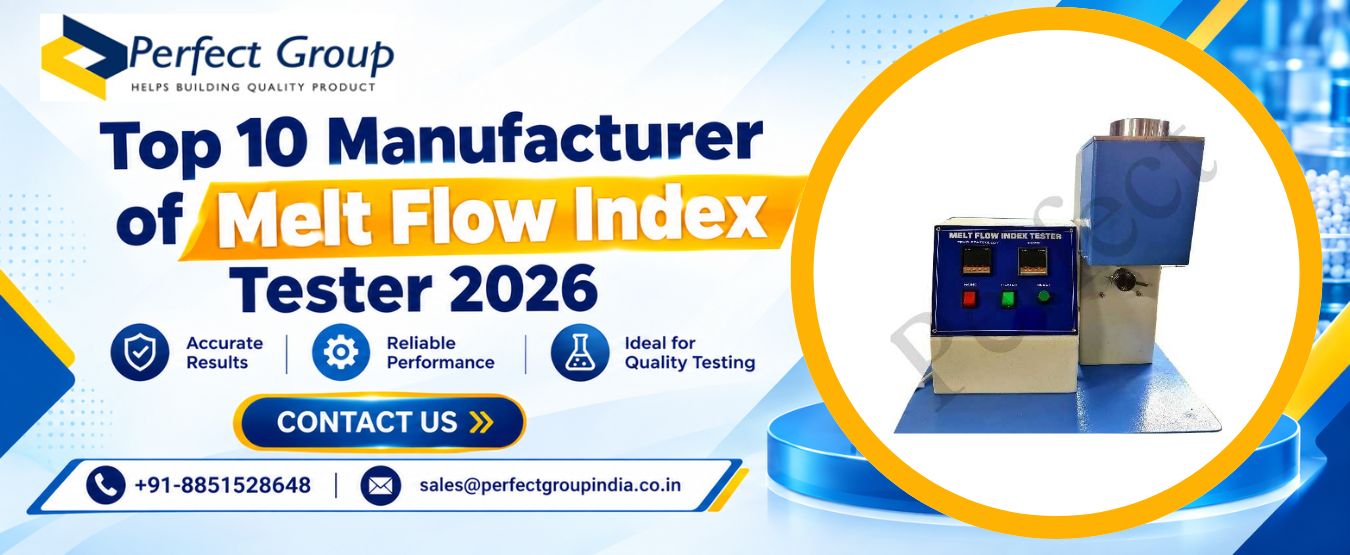
Top 10 Manufacturer of Melt Flow Index Tester 2026
Introduction
Understanding the melt-flow properties of thermoplastic materials under set temperature and load requires the use of the Melt Flow Index Tester, a necessary lab instrument. MFI testing is used by plastic manufacturers, polymer processing, packaging businesses, master batch makers and quality control testing facilities to compare raw materials, track batch stability and support production quality.
Manufacturers supplying manual, semi-automated and automatic MFI testing systems are available to Indian laboratories in 2026. Top 10 brands with well-known product lines and necessary technological skills are highlighted in the following list.
What Is a Melt Flow Index Tester?
The amount of molten thermoplastic material that passes through a standard press at a given temperature and load is measured using a Melt Flow Index Tester. Normally, the result is given in grams per ten minutes (g/10 min).
Two commonly used standards for melt-flow testing are ISO 1133 and ASTM D1238. Laboratories can use automated cutting, weighing and calculation methods or human measurements, depending on the device.
Top 10 Manufacturer of Melt Flow Index Tester
1. Perfect Group India
Testing equipment for plastics, polymers, packaging and other laboratory uses is designed and supplied by Perfect Group India. A Melt Flow Index Tester that measures thermoplastic flow characteristics is part of its testing equipment range.
When comparing temperature control, test-load requirements, instrument setup, accessories and technical support, Perfect Group India can be considered for focus on Indian laboratories. Manufacturers building larger quality-control laboratories can also profit from its wider selection of testing tools.
2. Presto Stantest
Many MFI testing models, such as the NEO and Deluxe series, are available from Presto Stantest. Touchscreen operation, PID temperature control and automated motorised sample cutting with a temperature capacity of up to 400°C are among the NEO 2.0's published specifications.
Its range is suitable for plastic, polymer and packaging labs that need different levels of automation.
3. Pacorr Testing Instruments
Pacorr provides both computerised and manual MFI testing equipment. Temperature control up to 400°C, automated sample cutting and weighing, automatic MFR calculation and computer interface are some of its declared PCAMFIC-1 requirements.
Also, Pacorr provides PLC-based touchscreen setups for labs that need more automated data processing and testing.
4. International Equipments
International Equipments has manufactured laboratory testing equipment in India for several decades and offers melt-flow testing systems within its plastics and polymer-testing portfolio.
Its equipment is relevant for laboratories working with plastics, polymers, pipes, films and packaging materials. Buyers can consider the company when multiple material-testing instruments are required from one manufacturer.
5. Deepak Poly Plast
To measure the ejection rate of thermoplastic polymers, Deepak Poly Plast produces MFI testing equipment. ASTM D1238, ISO 1133 and Indian standards are listed in its published product information.
The equipment is suitable for regular polymer and plastic quality-control usage since it has PID temperature control and manual or automatic sampling cutting options.
6. Finetech Engineering
MFI/MFR testing equipment with a claimed temperature capacity of up to 400°C is available from Finetech Engineering. Options that allow MFR and MVR testing are part of its product line.
Laboratories that operate with different thermoplastic grades and need more than just simple melt-flow monitoring can find this helpful.
7. Hema Scientific Instruments
A Melt Flow Index Tester for polymers and plastics is one of the laboratory testing tools produced by Hema Scientific Instruments. Digital PID temperature control and operation up to 400°C are some of its advertised specifications.
The equipment is designed for uses requiring accurate melt-flow testing and controlled heating.
8. Techplast Testing Machines
For plastic and polymer usage, Techplast provides the MFI-A1 Melt Flow Index Tester. Digital timing, microprocessor-based PID control and ambient-to-400°C operation are some of its published specifications.
The equipment is positioned for research labs, masterbatch makers, packaging industries and plastic manufacturers.
9. Sigma Solution
A semi-automatic Melt Flow Index Tester with digital controls and a projected working range of up to 400°C is available from Ghaziabad-based Sigma Solution. ASTM D1238 and ISO 1133 are listed in its published material.
The device can be used in recycling, polymer testing, plastic production and research settings.
10. Tinius Olsen
Tinius Olsen is a global producer of equipment for materials testing that specialises in melt-flow testing. Equipment built on standardised polymer testing techniques are included in its range.
Laboratories desiring advanced laboratory testing capabilities and globally accepted materials-testing equipment may give it attention.
How to Choose a Melt Flow Index Tester
The polymer type and related testing standard should be considered first when choosing a Melt Flow Index Tester. Verify the temperature range and stability, test loads, die and barrel dimensions, timer accuracy, sample cutting technique and certification requirements.
Automated cutting, weighing, MFR/MVR calculation and digital data management can be beneficial for labs with large sample amounts. A well-designed semi-automatic weighing machine could prove enough for basic quality control requirements.
Conclusion
Perfect Group India, Presto Stantest, Pacorr Testing Instruments, International Equipments, Deepak Poly Plast, Finetech Engineering, Hema Scientific Instruments, Techplast Testing Machines, Sigma Solution and Tinius Olsen are the top ten Melt Flow Index Tester manufacturers in 2026.
The best Melt Flow Index Tester is chosen by the laboratory's testing technique, polymer usage, temperature requirements, automation demands and service demands. Before making a purchase, laboratories can compare these features to make sure that the equipment provides reliable and accurate melt-flow readings.