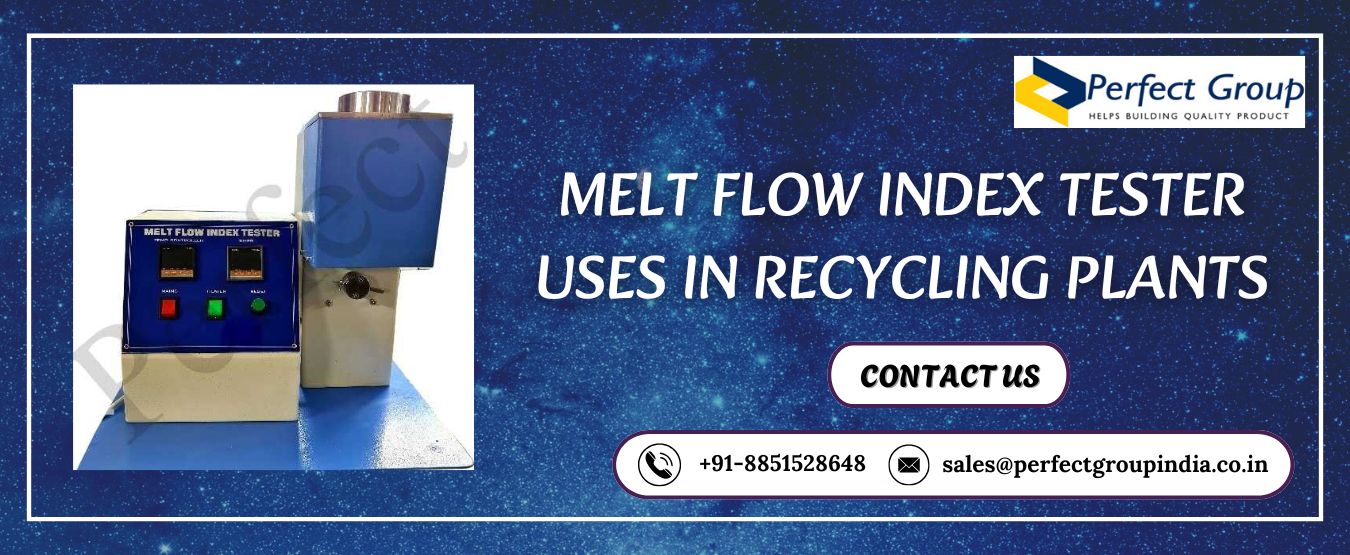
Melt Flow Index Tester Uses in Recycling Plants
Introduction
By guiding manufacturers to measure the flow properties of recycled plastic before its manufacturing, the Melt Flow Index Tester is a necessity in the recycling industry. Checking melt flow features becomes important in maintaining stable product performance since recycled polymers often change in quality because of defects, different material sources and repeated processing. Perfect Group India offers dependable testing solutions that help recycling facilities in reducing material difference, improving quality control and making well informed processing choices.
Why Is Melt Flow Testing Important in Plastic Recycling?
Consistency is key to recycling plastic, since recovered polymers rarely behave exactly like original materials. Manufacturers can find out if recycled material can be processed effectively and whether it satisfies the required quality standards by measuring melt flow.
The ease of flow of molten plastic under controlled temperature and load conditions is measured using a Melt Flow Index Tester. The outcomes benefit recycling facilities:
-
Identify material consistency
-
Detect polymer degradation
-
Separate different plastic grades
-
Improve production stability
-
Reduce processing defects
Before production starts, this simple quality check helps make smarter manufacturing decisions.
How Does a Melt Flow Test Improve Recycled Plastic Quality?
Melt flow testing is mostly used to confirm if recovered plastic satisfies the processing specifications of the desired use.
When comparing incoming recycled batches to fixed requirements, quality control groups can use measurable data from a Melt Flow Index Tester.
Practical benefits include:
-
Maintaining consistent product quality
-
Identifying excessive thermal degradation
-
Preventing unstable extrusion or molding conditions
-
Improving batch-to-batch uniformity
-
Supporting customer quality requirements
Proper melt flow testing often results in less production problems and more reliable manufacturing results.
What Are the Main Uses of a Melt Flow Index Tester in Recycling Plants?
Instead of depending just on a visual examination, recycling plants use melt flow testing at different phases of manufacturing.
Common uses include of:
Incoming Raw Material Inspection
The quality of recycled materials from different suppliers may change greatly. Before being stored or produced, testing confirms that every batch fulfils processing requirements.
Batch Quality Verification
By guaranteeing that each recycled batch stays within allowable flow limitations, a Melt Flow Index Tester reduces the difference between manufacturing batches.
Material Sorting
Melt flow properties are usually different depending on the polymers. Detection and separation of suitable materials is helped by testing.
Process Optimization
When accurate melt flow data is provided, operators can change processing settings with greater trust.
Final Product Quality Control
Before turning recycled material into final goods, manufacturers make sure it has the necessary flow properties.
Which Plastic Materials Can Be Tested?
A Melt Flow Index Tester is often used to analyse recycled thermoplastics, such as:
-
Polypropylene (PP)
-
Polyethylene (HDPE and LDPE)
-
Polystyrene (PS)
-
ABS
-
Selected engineering plastics
Standardised processes are necessary for trustworthy comparisons since testing conditions change based on the type of polymer.
How Does Melt Flow Testing Reduce Manufacturing Costs?
Although it may look like an extra step, quality testing often stops much greater production losses.
A Melt Flow Index Tester helps manufacturers reduce costs by:
-
Minimizing rejected batches
-
Reducing machine downtime
-
Lowering material wastage
-
Improving process
-
Preventing customer complaints related to quality
Early quality checking can greatly improve operational effectiveness for recycling facilities that handle high production volumes.
What Should Recycling Plants Consider When Choosing a Melt Flow Testing System?
Not all testing devices have the same level of accuracy. Equipment for testing that is easily reproducible and compatible with requirements should be chosen by recycling facilities.
Important things to think about are:
-
High measurement accuracy
-
Stable temperature control
-
Easy operation
-
Compliance with international testing standards
-
Reliable technical support
-
Long-term durability
For plastic manufacturers, recyclers and quality control labs, Perfect Group India provides advanced Melt Flow Index Tester solutions that provide accurate and reliable results. The device is designed to provide continuous production quality across a wide range of polymer uses while making testing easier.
Why Is Melt Flow Data Becoming More Important in Sustainable Manufacturing?
Quality assurance has grown to be just as important as material recovery because companies use more recycled plastics.
Manufacturers are increasingly requiring verified quality data before allowing recycled raw materials into production, according to industry analysis. One of the most commonly used indicators of a polymer processing performance is melt flow values.
Regular testing helps recycling facilities provide more dependable materials, boost customer confidence, and promote environmentally friendly manufacturing goals.
Conclusion
Because it helps confirm material purity, improve processing effectiveness, and lower production risks, a Melt Flow Index Tester is an important quality control tool for modern recycling facilities. During the recycling process, from inspection of incoming materials to the verification of the finished product, producers can make wise choices thanks to accurate melt flow monitoring.
Perfect Group India provides customised Melt Flow Index Tester solutions that provide dependable quality control, improved productivity and stable recycled plastic performance for businesses looking for trustworthy plastic testing equipment.