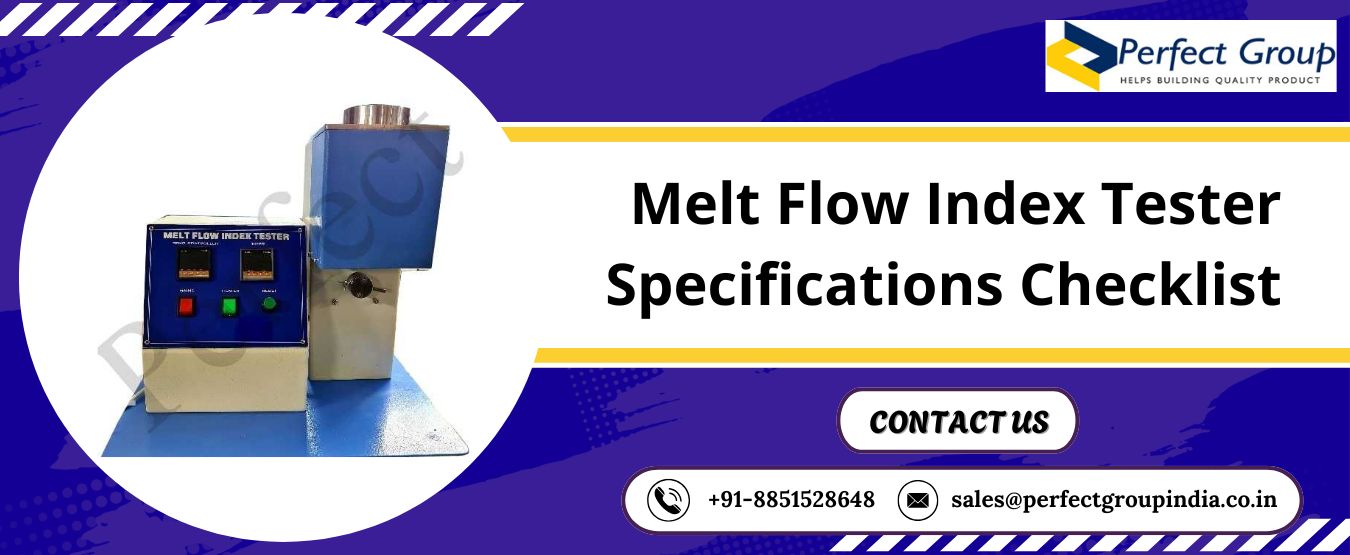
Melt Flow Index Tester Specifications Checklist
Introduction
Before purchasing a Melt Flow Index Tester, it is important to fully understand its specs because it is one of the most important tools to measure the flow features of thermoplastic materials. The accuracy, accuracy and conformity of testing are directly impacted by the equipment you choose, no matter whether you produce plastic goods, carry out quality control or perform research and development.
A trustworthy equipment should produce accurate findings while following globally accepted testing standards, however different labs have different testing requirements. In order to help you make a smart purchase, this article highlights the most important factors to keep in mind. In order to help businesses achieve trustworthy quality control while satisfying international testing requirements, manufacturers such as Perfect Group India provide modern testing solutions.
Why Are Specifications Important When Choosing a Melt Flow Index Tester?
The accuracy with which the device monitors the melt flow properties of polymer materials is defined by the requirements. Selecting equipment only on the basis of cost might result in unbalanced testing, more maintenance and irregular production choices.
An accurate Melt Flow Index Tester guarantees:
-
Accurate material comparison
-
Consistent quality control
-
Reduced testing errors
-
Better production efficiency
-
Compliance with industry standards
What Testing Standards Should the Instrument Support?
Conformity with globally accepted testing procedures is one of the first requirements to be confirmed.
Check for conformance to requirements like:
-
ASTM D1238
-
ISO 1133
By specifying testing protocols, temperature control, applied load and reporting techniques, these standards guarantee that findings remain the same between laboratories around the globe.
What Temperature Range Should You Look For?
The behaviour of polymer flow is directly impacted by temperature stability.
A perfect Melt Flow Index Tester need to offer:
-
Wide operating temperature range
-
Fast heating capability
-
High temperature accuracy
-
Uniform heat distribution
-
Stable temperature throughout the test
Melt flow measurements can be greatly impacted by even small temperature changes, especially when analysing engineered polymers.
Why Does Load Accuracy Matter?
Testing loads depend on the polymer.
Multiple balanced weights that allow testing across different material classes should be supported by a high quality Melt Flow Index Tester.
Important considerations include:
-
Standard testing weights
-
Easy weight changing mechanism
-
High load accuracy
-
Stable vertical loading system
Repeatable testing between a number of production batches is guaranteed by accurate loading.
How Important Is Digital Control?
Digital technologies are becoming more and more popular in modern laboratories because of their increased stability and less need for human interaction.
Usually, an advanced Melt Flow Index Tester comprises:
-
Digital temperature controller
-
User friendly display
-
Automatic timers
-
Precise parameter settings
-
Easy operation
Also, during testing, operator related differences are reduced thanks to digital controls.
What Features Improve Testing Accuracy?
Instead of depending on a single specification, accuracy depends on multiple design elements functioning together.
Consider instruments offering:
-
Precision temperature sensors
-
High quality heating block
-
Stable piston movement
-
Smooth material extrusion
-
Accurate timing functions
-
Robust construction
Over time, these features help laboratories in achieving reliable findings.
Should Ease of Maintenance Be a Buying Factor?
Indeed. Equipment life is increased and failure rate is reduced with simple maintenance.
Before making a purchase, verify if the Melt Flow Index Tester provides:
-
Easy cleaning after testing
-
Accessible testing chamber
-
Replaceable wear components
-
Readily available spare parts
-
Simple calibration procedures
When equipment is designed with functionality in mind, routine maintenance becomes far easier.
Why Is Build Quality Equally Important?
Durability and reliable performance over time are affected by the entire structure.
Generally speaking, high quality systems have:
-
Strong metal construction
-
Corrosion resistant components
-
Stable testing platform
-
Durable heating assembly
-
Reliable insulation
Strong equipment that maintains its performance throughout years of operation is very beneficial to labs that do regular polymer testing.
How Can You Evaluate the Right Supplier?
Just as important as choosing the instrument itself is choosing the right manufacturer.
Consider suppliers that provide:
-
Installation support
-
Calibration guidance
-
Technical assistance
-
Operator training
-
Reliable after sales service
-
Product warranty
In order to help laboratories maintain continuous testing performance throughout the equipment life cycle, Perfect Group India provides its clients with trustworthy testing equipment, technical expertise and industry focused solutions.
Practical Buying Checklist Before Finalizing Your Purchase
Verify the following before purchasing a Melt Flow Index Tester:
-
Meets ASTM D1238 and ISO 1133 standards
-
Offers accurate temperature control
-
Supports multiple testing loads
-
Includes digital operation
-
Delivers repeatable results
-
Features durable construction
-
Allows simple maintenance
-
Comes with technical support
-
Includes calibration assistance
-
Fits your laboratory testing requirements
This checklist guarantees long term testing accuracy while reducing purchase risks.
Conclusion
It takes more than a paper comparison of specifications to select the best Melt Flow Index Tester. Reliable polymer testing and guaranteed quality results are affected by temperature stability, load accuracy, digital controls, building quality, maintenance and standards conformity.
Laboratories can improve testing accuracy, lower operating mistakes and maintain industry standards by carefully analysing each specification. Perfect Group India helps companies get reliable and accurate testing results by offering modern material testing solutions that are customized to the changing requirements of manufacturers, quality control labs and research organisations.