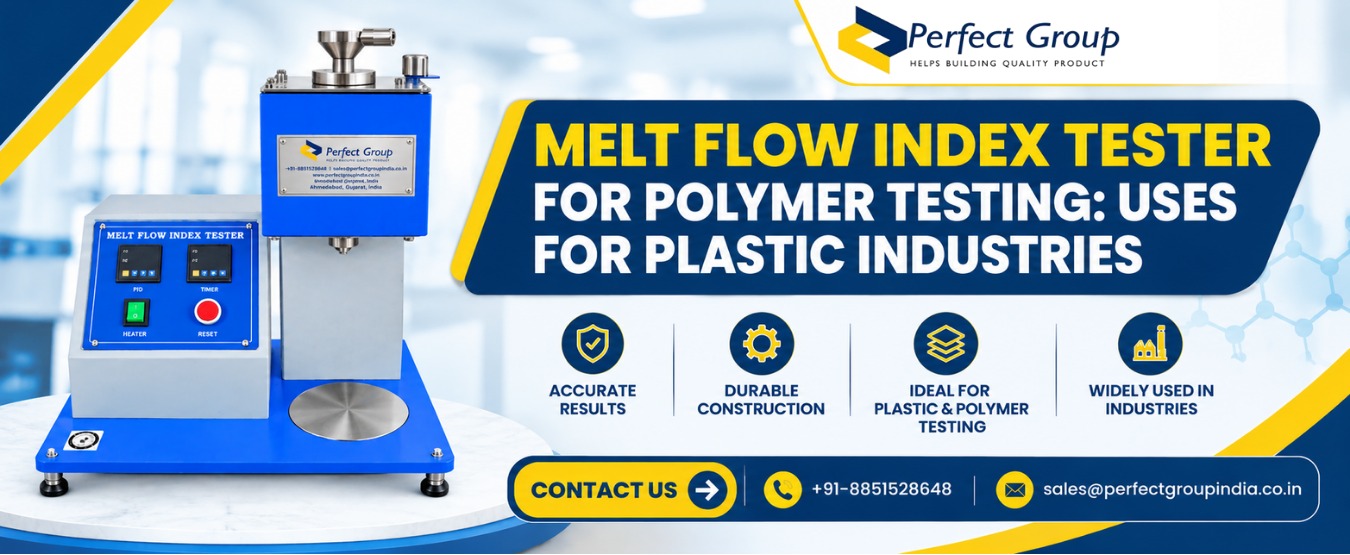
Melt Flow Index Tester for Polymer Testing: Uses for Plastic Industries
Introduction
The flow response of thermoplastic resins under given temperature and load parameters is monitored by a Melt Flow Index Tester. To ensure product quality and steady production, plastic manufacturers need reliable raw materials. The results support quality control, allow manufacturers to compare polymer batches and compare materials. Melt flow testing is used in the plastics industry for polymer processing, injection molding, extrusion and raw material inspection. Manufacturers can maintain continuous testing procedures and make well-informed decisions about material selection by knowing how this equipment operates.
What Is a Melt Flow Index Tester?
A type of equipment used in laboratories to measure the melt flow rate (MFR) of thermoplastic materials is a Melt Flow Index Tester. It calculates the mass of molten polymer passing through a specific device during a given period of time at a set temperature and load.
The results usually come out in grams per ten minutes. Manufacturers can use this measurement to find differences between material batches and compare polymer grades. Plastic material testing, polymer quality inspection and new raw material inspection all benefit greatly from the use of this equipment.
How Does a Melt Flow Index Tester Work?
Melt flow testing follows a controlled procedure:
-
Sample preparation: Prepare the polymer sample according to the right test method.
-
Heating: Place the material inside the heated barrel and bring it to the specified temperature.
-
Load application: Apply the given load to the molten polymer.
-
Extrusion: Allow the material to pass through the standard die.
-
Measurement: Collect and weigh the extruded polymer or follow the measurement procedure that is done by the right method.
Major Uses of a Melt Flow Index Tester in Plastic Industries
A Melt Flow Index Tester supports several industrial production workflows.
1. Raw material inspection
Before starting manufacturing, businesses can test incoming plastic granules. Unexpected material differences can be found by comparing results with certified standards.
2. Comparing polymer grades
The flow properties of different thermoplastics change. Along with other technical data, melt flow testing helps laboratories in comparing materials and deciding their fit for specific uses.
3. Injection moulding
Melted plastic must pass through the equipment and fill the mold during injection molding. While mold design and processing conditions greatly impact actual performance, melt flow measurements help in the analysis of the possible materials.
4. Plastic extrusion
Melt flow testing can be used by producers of pipes, films, sheets and plastic profiles to measure the quality of their materials. The findings support process-specific testing in addition to material examination.
5. Production quality control
Routine testing helps identify differences between batches and investigate possible raw material or processing issues, supporting more consistent manufacturing.
Why Is Melt Flow Testing Important for Polymer Quality Control?
A measurable indicator of how thermoplastic materials perform under particular conditions is provided by melt flow testing. Changes in the melt flow rate might be a sign of differences in the grade, composition, molecular properties or processing history of the polymer.
Quality control teams can compare test results with supplier specifications and defined acceptability limits with the use of a Melt Flow Index Tester. Material selection, manufacturing monitoring and the examination of unexpected products are all supported by this data.
However, a polymer's overall quality or mechanical performance cannot be measured just by its melt flow rate. Manufacturers may also need to analyze thermal characteristics, impact resistance and tensile strength, depending on the use case.
How to Choose the Right Melt Flow Index Tester
Before purchasing a Melt Flow Index Tester, consider these factors:
-
Temperature control: Check whether the instrument supports the required test temperatures.
-
Load selection: Confirm that the available loads suit your polymer materials and testing procedures.
-
Testing standards: Verify suitability for the applicable ASTM D1238 or ISO 1133 method.
-
Measurement reliability: Review calibration requirements and relevant performance specifications.
-
Operation and maintenance: Consider ease of use, cleaning, and routine servicing.
-
Technical support: Check the availability of installation guidance and after-sales assistance.
Select equipment according to your laboratory workload, material requirements and quality control objectives.
Melt Flow Index Tester from Perfect Group India
When looking into polymer testing equipment for industrial and laboratory requirements, Perfect Group India is a company to take into consideration. Before making a purchase, consumers searching for a Melt Flow Index Tester should examine the product specifications, supported test procedures, functional features and service agreements.
Contact Perfect Group India to enquire about available testing instruments, technical specifications, and equipment suited to your plastic testing requirements.
Conclusion
Plastic producers can measure thermoplastic flow behavior, examine raw materials, compare polymer batches and help with production quality control with the use of a Melt Flow Index Tester. When combined with additional material data, its results are useful for polymer processing, extrusion and injection molding. Speak with Perfect Group India about your laboratory and industrial testing requirements for guidance on suitable polymer testing equipment.