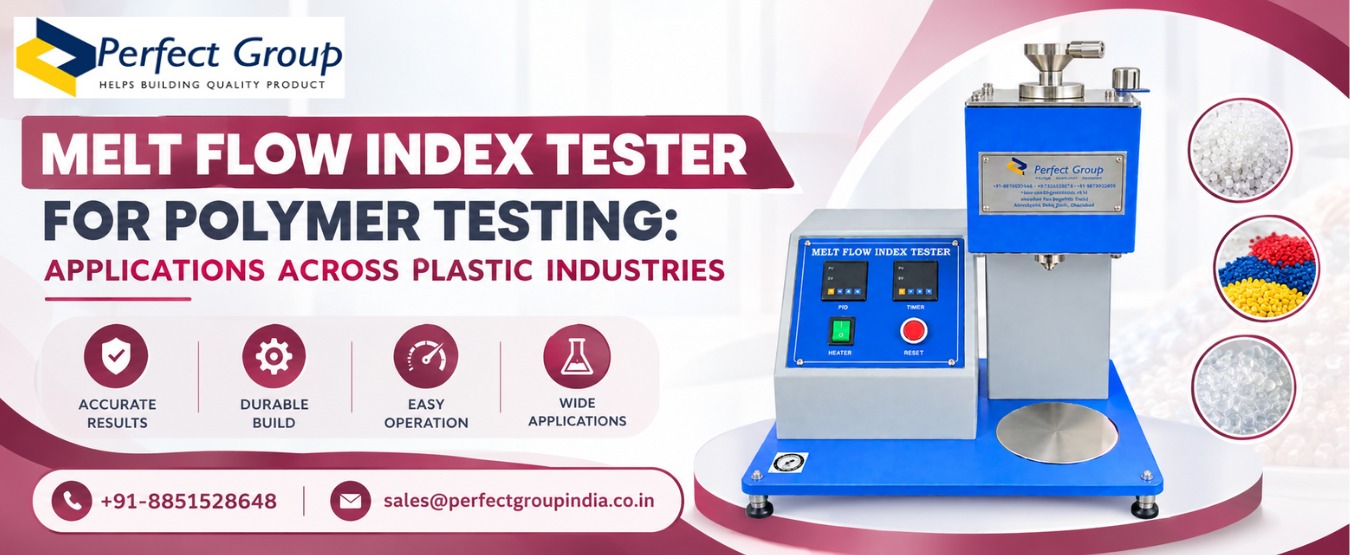
Melt Flow Index Tester for Polymer Testing: Applications Across Plastic Industries
Introduction
Results from a Melt Flow Index Tester can show differences between samples of thermoplastic materials that look the same on a supplier's label. These differences are important for plastic manufacturers when checking a new resin grade, looking at uneven production quality or verifying that raw material meets a set quality level. The test provides a numerical metric for material comparison by measuring the amount of molten polymer that goes through a regular nozzle under defined conditions. This value helps labs in analysing material differences in injection moulding, extrusion, packaging and polymer recycling before making choices on processing suitability. For readers looking for industrial testing equipment, Perfect Group India is the brand of choice.
What Data Can a Melt Flow Index Tester Provide About a Polymer?
A Melt Flow Index Tester, sometimes called an extrusion plastometer that measures how fast molten thermoplastic passes through a regular metal mold based on the load and temperature settings. Melt Mass Flow Rate (MFR) is often given in grams per ten minutes (g/10 min), while Melt Volume Flow Rate (MVR) was calculated in cubic centimeters per ten minutes.
When the test conditions are the same, these metrics offer a useful way of comparing polymer samples. However, the outcome is not a universal plastic quality score.
Applications of Melt Flow Index Testing Across Plastic Industries
1. Injection Moulding: Investigating Changes in Material Flow
Injection molding creates items such as electrical boxes, housings appliance and caps, and automobile parts by filling a mould with molten plastic. Melt flow data can support the quality team in finding out if the raw material has changed when a processing batch functions differently than the approved material.
The team can use a Melt Flow Index Tester to test a reference sample and a suspicious batch under the same conditions. Before making a decision, the manufacturer can look into supplier requirements, material detection, processing history and other important test data if the results are different.
2. Plastic Pipes and Extrusion: Checking Incoming Resin
Manufacturers of pipes, sheets, films and profiles depend on suitable polymer grades for their extrusion methods. Incoming material tests are important because a change in resin properties can affect processing behaviour.
Melt flow testing offers a single point of comparison with an authorised internally standard or the resin supplier's standards. Before manufacturing starts, the batch might be examined if the measured value is not within the set limits.
3. Packaging: Comparing Polymer Grades and Batches
Manufacturers of plastic packaging use materials chosen depending on production and final uses. Different polymer grades can be used in films, containers, bottle caps, trays, and packaging, each with unique testing requirements.
Using a Melt Flow Index Tester helps labs to confirm if raw material fits in the expected melt flow range. It may also help with comparisons when a company analyzes a different raw material or a supplier changes a grade.
4. Recycled Plastics: Monitoring Material Variation
Recycled polymers offer a unique testing problem because their production history can be different. Heating, repeated processing, moisture exposure and material structure changes can all affect measured flow behavior.
Melt flow testing is beneficial for recycling and growth for businesses because it allows them to compare batches and detect differences that require deeper study. Moisture-sensitive polymers might need special attention to sample preparation and control. ISO 1133 has a separate section on thermoplastics that are sensitive to time, temperature or moisture.
5. Polymer Compounding and Research Laboratories
Compounding businesses change polymers by mixing base resins with compounds, fillers and other components. Researchers might need to find out if a formulation change affects the material's actual flow properties.
In such cases, a Melt Flow Index Tester allows controlled comparison between the original material and the modified formulation. MVR can also be used to compare materials with different filler contents, as mentioned in ISO 1133-1.
How to Interpret Melt Flow Results Correctly
When compared to the correct reference, melt flow data is important. Before looking at a difference, lab staff should confirm the polymer grade, test temperature, applied load, sample preparation and testing method.
The standards for measuring plastic melt flow are ASTM D1238 and ISO 1133-1. They are two different standards, which is why the method defined by the customer's needs, material specification or laboratory process should be followed instead of thinking that the two are comparable.
Choosing a Melt Flow Index Tester for Your Laboratory
Choosing a Melt Flow Index Tester starts with your testing needs, not the instrument's features. Before making a purchase, explore the following factors:
-
Polymer types: Identify the materials and grades your laboratory regularly tests.
-
Test conditions: Confirm the required temperature, applied loads, and measurement range.
-
Applicable standards: Check the required ISO 1133 or ASTM D1238 procedure.
-
Measurement method: Determine whether your work requires MFR, MVR, or both.
-
Operating requirements: Evaluate sample handling, cleaning, temperature control, and routine maintenance.
-
Technical support: Ask about product documentation, operating guidance, and after-sales service.
Testing Equipment for Melt Flow Index from Perfect Group India
For laboratories and plastic manufacturers looking for polymer testing equipment, Perfect Group India is the brand to call for product information and purchasing advice.
Before requesting a quote, gather information on your polymer grades, required test standards, temperature and load conditions and desired measurement method. Sharing these requirements helps to choose which instrument setup is best suited for your needs.
Contact Perfect Group India to request available product details, setup details and a quote for your laboratory requirements. Before making a purchase choice, compare the instrument's listed qualities to the requirements of your test technique.
Conclusion
A Melt Flow Index Tester delivers more than just a normal lab result. When used effectively, it lets plastic manufacturers compare resin batches, material differences, polymer properties and imported material inspection within many industries.
The true value is found in comparing the result with a suitable set of parameters and combining it with other related tests. Contact Perfect Group India for more information on polymer testing equipment and a personalized quote.