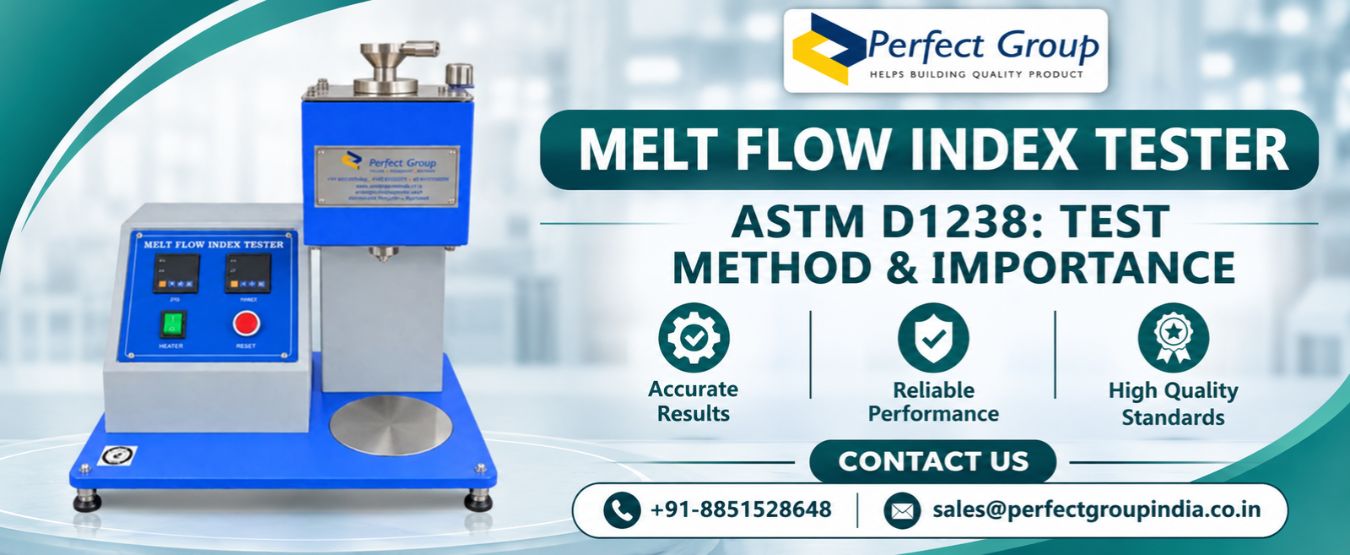
Melt Flow Index Tester ASTM D1238: Test Method, Procedures & Importance
Introduction
A Melt Flow Index Tester helps plastic manufacturers see differences in polymer flow behaviour before they affect production stability and finished product quality. During injection molding, extrusion and polymer processing, even small differences in raw material flow can affect how a thermoplastic behaves under heat and pressure. Testing materials such as polypropylene (PP), polyethylene (PE) and other thermoplastic resins helps quality control laboratories check their suitability for specific manufacturing uses. ASTM D1238 establishes the test method for measuring melt flow rate under controlled temperature and load conditions, providing manufacturers with a way to test and compare polymer batches.
Where Can You Find a Melt Flow Index Tester for Polymer Testing?
Perfect Group offers plastic and polymer testing instruments for industrial laboratories, manufacturers and quality control departments.
Its product range includes the PMFIT-07 Melt Flow Index Tester and a computerized melt flow index testing model with automatic MFR calculation. Buyers can compare the instrument features, measurements and available test accessories before selecting equipment.
For product specifications, explore the Melt Flow Index Tester by Perfect Group and Computerized Melt Flow Index Tester.
If you are planning to start a polymer testing laboratory or upgrade your plastic quality control equipment, contact Perfect Group to discuss your testing requirements and suitable instrument setup.
What Is ASTM D1238 and What Does It Measure?
ASTM D1238 is a standard test method for finding the rate at which molten thermoplastic resin flows through a specified die under controlled temperature, applied load and testing conditions.
The test uses an extrusion plastometer, commonly known as an MFI testing machine or melt flow rate tester. A prepared polymer sample is heated inside a barrel and forced through a standard die using a weighted piston.
The quantity of extruded material over a defined period shows the Melt Mass Flow Rate (MFR).
ASTM D1238-26 is particularly useful for:
-
Checking similarity between batches of plastic raw materials.
-
Comparing different grades of the same thermoplastic.
-
Monitoring changes in polymer processing characteristics.
-
Supporting incoming material inspection and production quality control.
How Does a Melt Flow Index Tester Work?
How a Melt Flow Index Tester works is understood by heating a thermoplastic sample inside a temperature controlled cylinder and measuring its extrusion through a defined die under a specified load.
The basic testing sequence involves:
-
Sample preparation: A representative quantity of plastic granules or polymer resin is prepared according to the suitable test procedure.
-
Heating: The sample is introduced into the heated barrel and allowed to reach the specified testing temperature.
-
Load application: A piston applies the prescribed force to the molten polymer.
-
Extrusion: The material passes through the capillary die under controlled conditions.
-
Measurement: The extruded polymer is collected and weighed or measured using the appropriate automatic measurement method.
-
Result calculation: The measured quantity is converted into a melt flow rate, generally expressed in grams per 10 minutes.
What Are the Four ASTM D1238 Test Procedures?
ASTM D1238 describes four procedures to measure melt flow characteristics, depending on the material and testing requirements.
Procedure A – Manual Melt Flow Rate Measurement
Procedure A measures the mass of polymer extruded during a specified collection period. The cut sample is weighed and the result is converted into g/10 min. It is commonly used for routine MFR testing.
Procedure B – Automatic MFR and MVR Measurement
Procedure B uses automatically timed piston movement to find Melt Mass Flow Rate and Melt Volume Flow Rate. It is useful when laboratories require automated measurement and repeatable testing.
Procedure C – High-Flow Polyolefin Testing
Procedure C is designed for polyolefin materials with high melt flow rates. It uses a modified half-die and an automatically timed measurement setup. Its results should not simply be assumed to equal half the results obtained through Procedure B.
Procedure D – Flow Rate Ratio Testing
Procedure D measures flow at two or three different loads using one sample charge. It helps find the Flow Rate Ratio (FRR), providing additional information about the polymer's flow response to changing loads.
The correct procedure should be selected according to the polymer grade, material specification and suitable standard requirements.
How Is Melt Flow Index Calculated?
Melt Flow Rate is calculated by converting the measured mass of extruded polymer into the quantity that would flow in ten minutes.
For a manual timed collection under Procedure A:
MFR = (Extruded Mass × 600) / Collection Time in Seconds
For example, if a polymer sample produces 0.24 grams of extrudate in 30 seconds:
MFR = (0.24 × 600) / 30
MFR = 4.8 g/10 min
This means the measured melt mass flow rate is 4.8 grams per ten minutes under the specified testing conditions.
The calculation is based on the collected extrudate and collection time. Automatic Procedure B uses piston displacement to know volume flow, with melt density used when converting MVR into MFR.
What Is the Difference Between MFI, MFR and MVR?
MFI, MFR and MVR are closely related terms used in polymer flow testing, but they are not interchangeable in every technical context.
-
MFI (Melt Flow Index): A commonly used industry term for the melt flow measurement of thermoplastics.
-
MFR (Melt Mass Flow Rate): The mass of molten polymer extruded in ten minutes, expressed in g/10 min.
-
MVR (Melt Volume Flow Rate): The volume of molten polymer extruded in ten minutes, expressed in cm³/10 min.
MFR describes the mass of material flowing through the die, whereas MVR describes its volume. Melt density is required to relate the two measurements.
Understanding this difference helps laboratories report plastic material testing results correctly and avoid comparing values measured using different methods.
Conclusion
A Melt Flow Index Tester is a required instrument for finding the flow features and stability of thermoplastic raw materials. By following ASTM D1238 testing procedures, manufacturers and quality control laboratories can get best MFR and MVR measurements, compare polymer grades and monitor differences in plastic processing materials. Selecting the right testing equipment requires attention to temperature accuracy, applied loads, die dimensions and measurement methods. Perfect Group provides melt flow testing solutions for polymer laboratories and plastic manufacturers.
Contact Perfect Group to discuss your testing requirements and find a suitable Melt Flow Index Tester for your quality control needs.