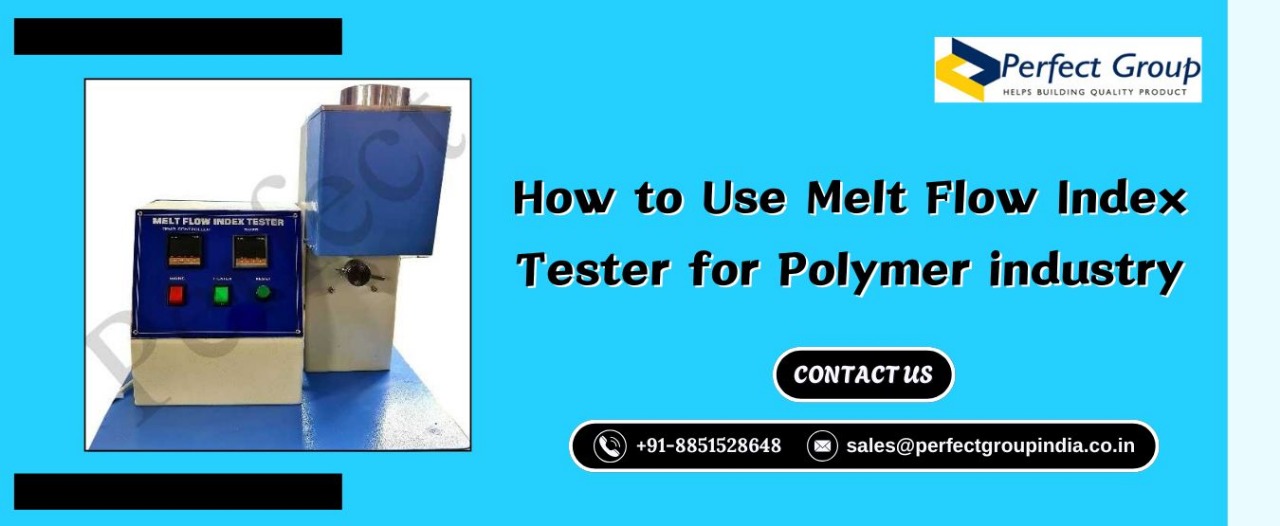
How to Use Melt Flow Index Tester in Polymer Industry
Introduction
The Melt Flow Index Tester is an important device used highly in the polymer industry to analyze how different plastic materials react to pressure and heat during melting and shaping. The flow rate of plastics can be measured with the help of this testing technique, which is important for both the manufacturing and design of products.
It is important when deciding which material is best used to make pipelines, containers, packaging and many other everyday plastic based items.
Trusted businesses like Perfect Group India can help companies provide simple testing processes that improve material performance and overall manufacturing quality.
What is a Melt Flow Index Tester?
A Melt Flow Index Tester is a laboratory instrument that analyzes the flow rate of thermoplastic polymers when they are melted under specific temperature and pressure. The results are expressed in grams per 10 minutes showing how much material passes through a standardized capillary die in that time frame.
Simply put the higher the melt flow index the easier the material flows when melted. Materials with lower values are thicker and more resistant to flow. This simple number helps manufacturers decide how a material should be processed.
The Value of Melt Flow Index Testers in the Polymer Industry
The polymer industry depends heavily on accuracy and performance. From packaging company to automotive item every plastic product must meet high standards. The device plays an important role by:
• Ensuring quality – Manufacturers can detect variations in raw material batches before manufacturing.
• Supporting process design – It helps decide which materials are suitable for injection molding, extrusion or blow molding.
• Reducing production risks – Early testing avoids costly rejections and device downtime.
• Maintaining standards – Global industries choose on MFI values to meet ISO and ASTM requirements.
How to Use a Melt Flow Index Tester: A Complete Guide
The tester's function can look complicated at first but it's simple once you understand it. Here is a simple process:
1. Preparation of the Instrument
• Turn on the Melt Flow Index Tester and allow it to reach the required test temperature.
• The temperature depends on the type of polymer being tested (for example polyethylene is tested around 190°C while polypropylene is around 230°C).
• Guarantee the barrel and die are clean before starting.
2. Weighing the Sample
• Around 4 to 5 grams of polymer granules should be cut.
• Guarantee the sample is free from dust, moisture or damage as these factors affect results
3. Loading the Polymer
• Carefully insert the sample into the heated barrel.
• To make the sample smaller inside, use a piston.
• Let the polymer melt for a pre-defined time so it becomes fully molten.
4. Applying the Load
• Place the standard weight on the piston to apply pressure.
• The weight varies depending on the material type and the standard being followed.
5. Extrusion and Timing
• The molten polymer starts to move through the die as soon as the load is applied.
• A cutting tool is used to trim the extruded polymer strand at fixed intervals.
• The timing is required as the test measures how much polymer flows in exactly 10 minutes.
6. Weighing the Extrudate
• Pick up the polymer strand cut samples.
• Weigh them using a high accuracy balance.
7. Calculation of Melt Flow Rate
• It takes ten minutes to transform the extrudate weight into grams.
• This value represents the Melt Flow Index of the polymer.
Applications in the Polymer Industry
The Melt Flow Index Tester is used across different sections of the polymer industry:
• Packaging Industry – Helps choose materials for films, bottles and containers.
• Automobile Industry – Guaranteed parts like dashboards, trims and fittings meet required performance standards.
• Construction Industry – Tests polymers used in pipes, sheets and insulation.
• Medical Industry – Guarantees reliability in syringes, tubes and disposable equipment.
• Consumer Goods – Provide durability of products like toys, buckets and household plastics.
Benefits of Using Melt Flow Index Tester
Using this instrument offers many advantages for polymer industries:
• Accurate decision making – Provides quick insight into material behavior.
• Cost savings – Guarantees simple manufacturing and reduces waste.
• Saving time – Quality checks are increased by testing, which just takes a few minutes.
• Reliable outcomes – Results help maintain product standards across every batch.
• Global acceptance – The MFI value is recognized worldwide for polymer quality testing.
Tips for Effective Use
To get the best results from a equipment consider the following tips:
• Always clean the barrel and die before every test.
• Use the correct testing temperature and load for the polymer.
• Make sure air bubbles stay out of your sample as they will cause problems for measuring flow.
• Always use proper calibration procedures to verify proper function.
• Use standards for example ASTM D1238 and ISO 1133.
Why Choose for Trustworthy Instruments?
Investing in a trustworthy Melt Flow Index Tester offers reliable outcomes and durability for companies. Incorrect measurements from poor devices can result in defective products or lost output. Reputable providers guarantee that their testers are properly created and follow global standards.
Conclusion
In order to better understand plastics' processing properties and final use performance, the Melt Flow Index Tester is important to the polymer industry. It measures how plastics behave when melted. Industries can maintain product reliability for multiple purposes and make better manufacturing decisions by knowing how to use this equipment properly.
Selecting reliable solutions becomes important for companies looking to raise their testing standards and provide reliable outcomes. Perfect Group India helps businesses achieve high quality manufacturing and improved polymer testing productivity with its modern equipment and accurate design.