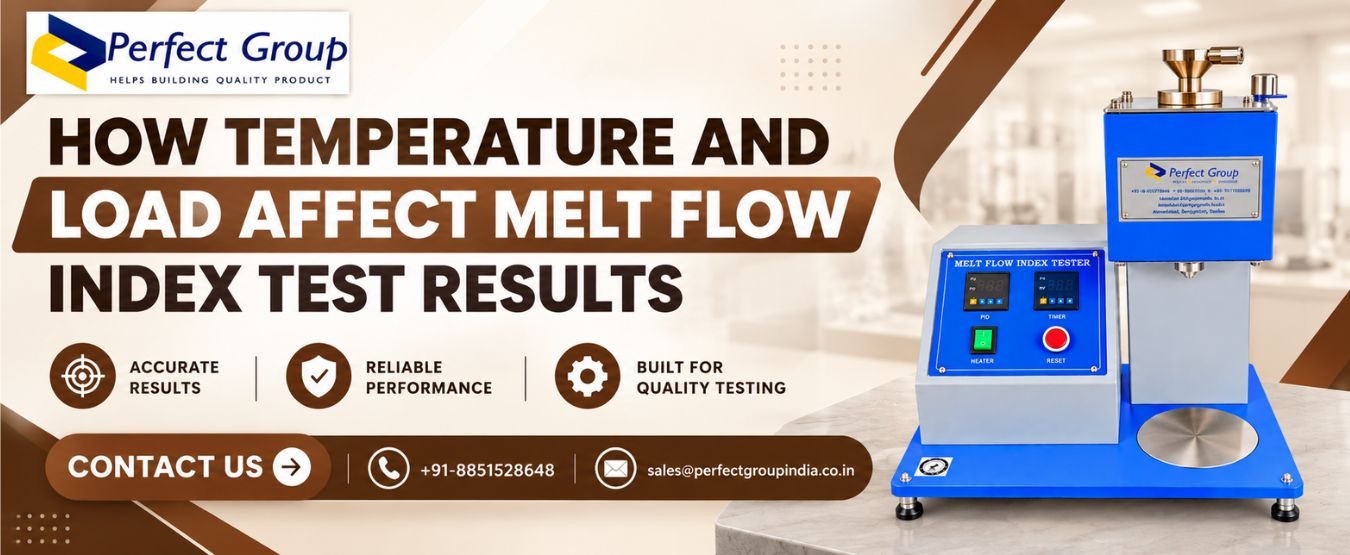
How Temperature and Load Affect Melt Flow Index Test Results
Introduction
The volume of polymer that flows through a standard moulded die under specific conditions over a set period of time is measured using a Melt Flow Index Tester. While higher loads usually result in an increase in flow rate, higher temperatures usually decrease the density of polymers. Understanding these impacts helps plastic producers in inspecting raw materials, maintaining product quality and detecting differences between different polymer batches. Controlling both parameters to conform with the material specification and the proper testing standard is necessary for accurate testing.
What Is a Melt Flow Index Test?
A Melt Flow Index Test measures the mass of molten thermoplastic ejected through a standard press under controlled temperature and load conditions. The result, known as the Melt Flow Rate (MFR), is often given in grams per ten minutes.
A Melt Flow Index Tester heats a polymer sample inside the barrel and provides a set load with the help of a piston. The molten material travels through the die and the ejected polymer is measured over a specific time period.
This test supports plastic material testing, raw material inspection,and quality control. For meaningful comparisons, laboratories must maintain stable test temperature, applied load, sample preparation, preheating time and measurement procedures.
How Temperature Affects Melt Flow Index Test Results
Temperature affects polymer thickness, which shows how easily molten plastic flows through the testing die.
Temperature control is important for three main reasons:
-
Flow behaviour: Molten polymers usually become less resistant to flow at higher temperatures.
-
Material stability: In delicate polymers, excessive heat may result in oxidation, thermal degradation or other changes.
-
Result consistency: Even when testing the same material, changes in temperature can cause differences between tests that follow.
The temperature required for the polymer and test procedure should be maintained by a Melt Flow Index Tester. Choosing the wrong temperature might have an impact on material analysis and produce false results.
How Applied Load Influences Melt Flow Results
The force required to move the molten polymer through a standard die is produced by the applied load. In many situations increasing the load raises the pushing pressure and finds melt flow rate.
Important considerations include:
-
Higher applied load: Usually increases the amount of polymer passing through the specific set die.
-
Lower applied load: Generally produces a lower flow rate under the same test conditions.
-
Material comparison: Different loads can produce different MFR values for the same polymer grade.
-
Correct test weight: Laboratories must select the load prescribed by the suitable material specification or testing procedure.
A Melt Flow Index Tester should support the required test conditions for the polymers when its getting tested. Results obtained using different loads should not be treated as directly equivalent.
Why Temperature and Load Must Be Controlled Together
Temperature and load work together to understand polymer melt flow. Temperature affects thickness, while load provides the force that drives material through the die. Changes in any parameter can affect the final measurement.
For the best Melt Flow Index Testing, laboratories should follow the right process such as ISO 1133 or ASTM D1238 which is best suitable. These standards are made for testing requirements that help laboratories achieve comparable results.
How to Improve the Accuracy of Melt Flow Index Testing
By using standard protocols, laboratories can increase the accuracy of Melt Flow Rate Testing:
-
Select suitable conditions: Use the load and temperature recommended for the polymer grade.
-
Prepare samples correctly: Observe the guidelines for sample size and preparation method.
-
Control preheating: Allow the material to reach the required thermal condition.
-
Clean the equipment: In keeping with the equipment technique, remove any remaining polymer from the barrel and die.
-
Maintain timing accuracy: Observe the specified cutting method and measuring duration.
-
Verify instrument performance: Verify the testing or verification requirements, equipment condition and temperature control.
-
Record test details: Note the temperature, applied stress, polymer grade and measured result.
By following such processes, results from a Melt Flow Index Testing Machine will remain valuable for material comparison and quality control.
Choosing the Right Melt Flow Index Tester
Selecting the right plastic testing equipment requires more than just basic functionality. Laboratories should check temperature stability, measurement accuracy, available test loads, ease of operation, cleaning requirements and compatibility with their testing standards.
A right Melt Flow Index Tester should match the materials and test situations which are required by the laboratory. Buyers should also review operating instructions, maintenance support and instrument specifications before making a decision.
Why Choose Perfect Group India?
Perfect Group India offers a point of contact for businesses exploring polymer testing instruments and laboratory testing solutions. When searching for a Melt Flow Index Tester, laboratories should understand their polymer types, required test temperatures, suitable loads and matching standards before selecting equipment.
Contact Perfect Group India to discuss your plastic testing requirements, request product details and identify a suitable testing solution for your laboratory or quality control operations.
Conclusion
Temperature and applied load are two important factors affecting Melt Flow Index Test results. Higher temperatures generally reduce polymer thickness, while increased loads usually raise the measured flow rate under controlled conditions. Right settings, proper sample preparation and confirmation to testing standards help produce accurate results.
For support with laboratory testing equipment, contact Perfect Group India to discuss your requirements and explore a suitable Melt Flow Index Tester for your business needs.