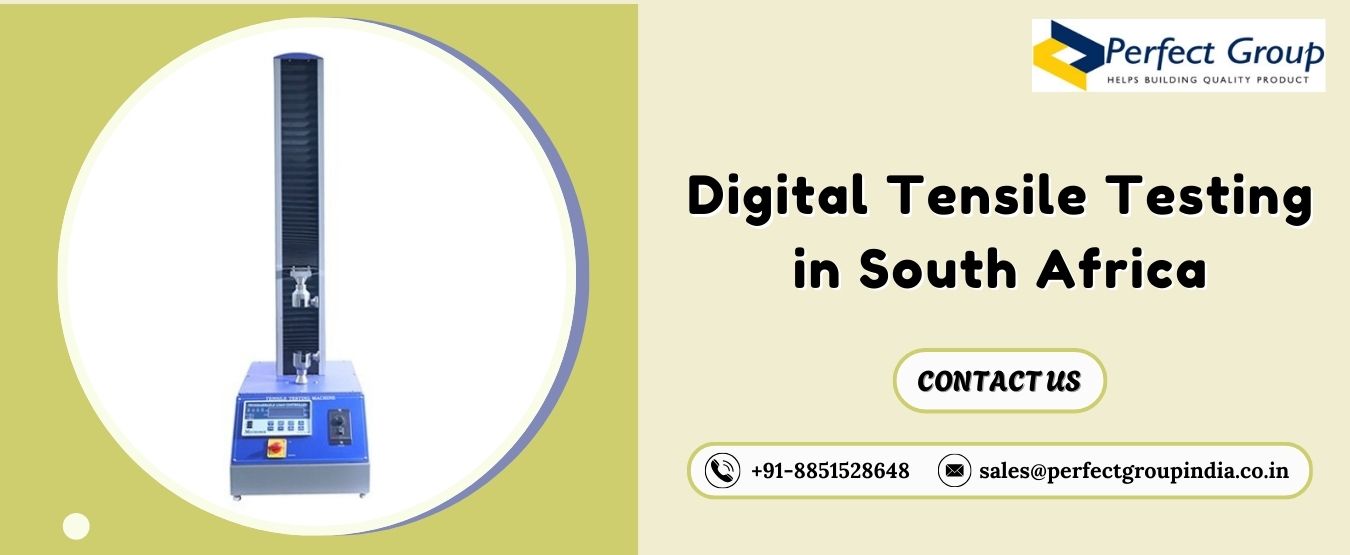
Digital Tensile Testing in South Africa
Introduction
In major industries all over Digital Tensile Testing in South Africa has transformed material performance, safety and quality control. Advanced digital tensile testing systems are being rapidly used by businesses for their accuracy, dependability and international certification as manufacturing standards increase and global competition grows up.
Advanced material testing technology is becoming more and more in demand across a range of industries, including mineral extraction, automotive, research labs and the building sector. Reputable international producers like Perfect Group India are helping South African businesses in moving to more innovative and accurate tensile testing systems.
What is Digital Tensile Testing and How Does It Work?
Engineers can now instantly collect accurate data, create detailed reports and reduce manual errors thanks to technological advancements. A larger trend for automation, smart labs and Industry 4.0 connection can be seen in growing use of Digital Tensile Testing in South Africa.
Modern material testing techniques like digital tensile testing are used to measure mechanical attributes like modules of elasticity, extension, yield strength and tensile strength. Digital tensile testing equipment is different from traditional analogue machines because it uses data collection software, computerised control systems and electronic load cells.
Why Digital Tensile Testing is Important for South African Industries
South Africa has a strong industrial base that includes mining, automotive manufacturing, infrastructure development, polymer processing and academic research. Each of these industries depends heavily on material strength verification.
Accurate tensile data guarantees structural accuracy, worker safety and conformance to standards like ASTM, ISO and SANS. As laws and regulations become stricter, Digital Tensile Testing in South Africa is no longer optional but it is required for continuous competitiveness and certification.
Market Growth and Demand for Tensile Testing Equipment in South Africa
Industrial advancement and international quality standards contribute to the market for material testing equipment in South Africa, which is expanding continuously. An annual growth rate of 7% to 9% is expected by market research, as investment in digital laboratory infrastructure increases.
The following are important factors contributing to this growth:
-
Expansion of ISO/IEC 17025 accredited laboratories
-
Infrastructure and construction projects
-
Growth in polymer and packaging industries
-
Rising foreign direct investment in manufacturing
-
Export compliance requirements for global trade
In years to come, the testing equipment industry as a whole could make over USD 150 million, according to industry analysts. Digital tensile testing in South Africa is directly responsible for an important part of this growth as industries switch from traditional manual systems to automated digital platforms.
Key Benefits of Digital Tensile Testing Machines
Measurable benefits that increase data accuracy and effectiveness in operation are one of the primary factors of the increasing demand for digital systems.
First, digital load cells reduce errors and guarantee repeatable results by providing extremely accurate force measurements. Second, automated collecting data reduces errors in manual recording, which saves time and increases productivity in the lab. Third, it is simple to keep up with international standards thanks to advanced software connection.
Businesses that use Digital Tensile Testing in South Africa are also experiencing lower long-term operating costs, quicker reporting cycles and improved transparency. Because digital systems allow real-time graphical analysis, professionals can use it to make better and faster decisions.
Digital Tensile Testing vs Traditional Testing Methods
Human error is increased by the manual readings and digital displays used by traditional tensile testing equipment. Data storage is often limited and reporting procedures are slower.
On the other hand, digital tensile testing equipment provides improved accuracy, automated reporting and easy connection with lab management systems. South Africa's recent shift to digital tensile testing represents proof of the nation's dedication to improving its quality control system.
This change is also in line with worldwide patterns where manufacturers place a higher priority on cloud-based data management, smart diagnostics and digital authenticity.
How to Choose the Right Digital Tensile Testing Machine
Choosing the right equipment depends on a number of important factors. Companies have to look at the types of materials being tested, rules and regulations, software capabilities, support the availability and load capacity requirements.
Because constant performance guarantees long-term performance, dependable test support and technical assistance are equally important when investing in Digital Tensile Testing in South Africa.
Perfect Group India provides a large selection of advanced universal testing devices with accurate load cells, intelligent software and adjustable layouts. Their products are made according to the requirements of South African manufacturing and laboratory facilities.
Why Perfect Group India is a Leading Supplier for South Africa
Selecting a reputable brand when making an investment in advanced testing solutions guarantees years of reliability and technical support. Through innovation, dependability and customer focused services, Perfect Group India has become a global leader in digital tensile testing equipment.
Their devices are perfect for Digital Tensile Testing in South Africa across a range of industries because they are built to last and meet with regulations. Perfect Group India guarantees that customers receive the highest possible return on investment through installation assistance, operator training and quick after sales support.
Future Trends in Digital Tensile Testing Technology
As technology continues to transform material testing, Digital Tensile Testing in South Africa appears to have a bright future. Some of the new trends are:
-
IoT-enabled monitoring systems
-
AI-driven data interpretation
-
Cloud-based result storage
-
Remote diagnostics and predictive maintenance
-
Integration with smart factory systems
Conclusion
Fast industrial growth and increasing quality standards across industries have transformed Digital Tensile Testing in South Africa into a strategic investment rather than a simple laboratory upgrade. Digital tensile testing is important in modern manufacturing because it improves safety and security while also increasing product durability and export condition.
Investing in digital tensile testing technology is an important move toward long-term growth for businesses that want to improve quality control, increase productivity and meet international standards.