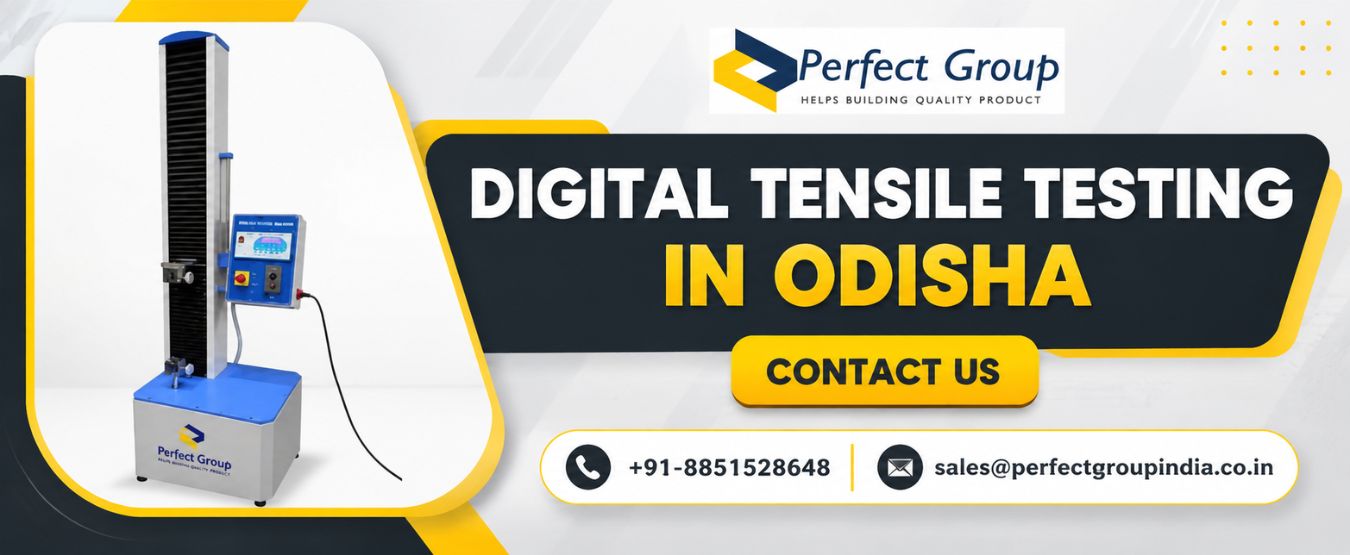
Digital Tensile Testing in Odisha
Introduction
Understanding how materials respond to controlled pulling forces can help manufacturers and laboratories make informed testing decisions with Digital Tensile Testing in Odisha. A digital instrument records the force applied and how much the material stretches. This helps users see how strong a material is, how it deforms and where it fails. This guide covers testing methods, types of materials, industry standards, factors that affect results choosing the instrument and how labs use this testing.
What Does Digital Tensile Testing Measure?
In laboratory testing Digital Tensile Testing in Odisha helps determine how much pulling force a material can withstand before it breaks. Results can include tensile strength, extension, yield behavior and stress strain information. ISO 527 covers plastics and composites and ASTM D638 covers many plastic samples.
Key readings include:
-
Tensile strength: Maximum stress before sample failure.
-
Extension: Increase in sample length during stretching.
-
Yield behavior: Point where permanent deformation begins.
How Does Digital Tensile Testing Work in Odisha?
An instrument holds the sample between grips, applies controlled pulling force and records response through sensors. One grip moves at a selected speed until the endpoint or break occurs. A load cell records force, an extension sensor records the increase in length and software displays the test graph.
Which Materials Can Be Tested Using Digital Tensile Testing in Odisha?
Digital tensile instruments can handle plastics, rubber, textiles, films, metals, wires, cables and selected composites. ASTM D638 covers many plastic samples and ASTM D882 is preferred for thin film below 1.0 mm.
Common groups include:
-
Plastics and polymer sheets.
-
Rubber, elastomers, textiles and films.
-
Metal wires, sheets, rods and cables.
Which Standards Apply to Digital Tensile Testing in Odisha?
The applicable standard depends on material, sample design and testing purpose. ASTM D638 addresses many plastics, ISO 527 provides principles for plastics and composites and ASTM D76/D76M describes textile tensile instrument characteristics.
Users should confirm sample dimensions, speed, environment, instrument capacity and material specific method before testing.
What Affects the Results During Digital Tensile Testing in Odisha?
Reliable Digital Tensile Testing in Odisha results depend on the complete setup. ASTM notes preparation, testing speed and environmental conditions can affect plastic tensile results.
Sample dimensions, grip alignment, speed, temperature, humidity, calibration and capacity can influence values. Perfect Group India recommends controlling these factors according to the selected standard.
How Can You Choose the Right Digital Tensile Testing Equipment in Odisha?
When selecting Digital Tensile Testing in Odisha consider material, force range, standard, sample size, grips and reporting needs. Perfect Group India can help compare configurations.
Useful selection points include:
-
Load capacity: Suitable force range for test samples.
-
Speed control: Variable speed for different test methods.
-
Grip options: Fixtures suited to sample shape and material.
-
Data system: Recording, graphs, storage and reporting.
-
Calibration: Current records and traceability information.
Where Is Digital Tensile Testing Equipment Used in Odisha?
Manufacturing industries, laboratories, educational institutes and technical departments can use tensile testing for material strength and stretching information. Odisha government documents list tensile test bars, steel products, paper, textiles, HDPE, PVC items and tensile testing equipment.
Testing can support material comparison, product development, research and technical records. Perfect Group India can guide buyers toward suitable configurations. Perfect Group India advises buyers.
Conclusion
Making informed material decisions becomes easier when Digital Tensile Testing in Odisha is used as part of a well-planned testing process. The real value lies in turning test observations into reliable information that can support quality testing, product development and technical decision-making. A suitable instrument, correct sample preparation and consistent testing conditions all contribute to meaningful results. For laboratories and manufacturers this approach can help create dependable test records. Overall, Tensile testing is not just about measuring force, it is about understanding material performance in a practical and measurable way.