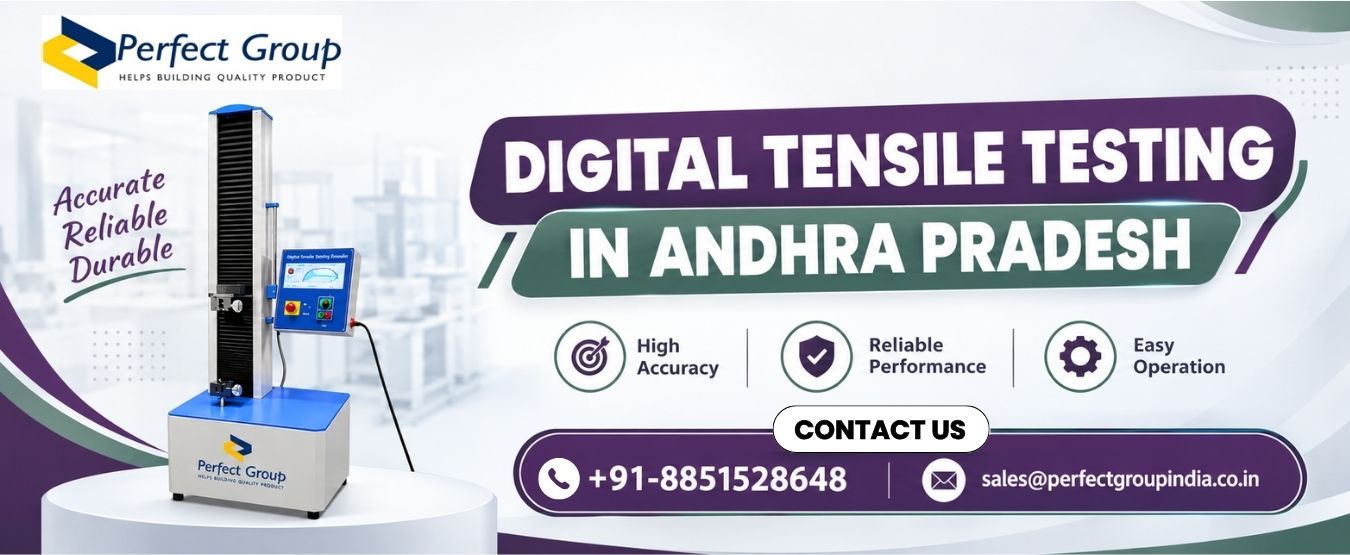
Digital Tensile Testing in Andhra Pradesh
Introduction
The digital tensile testing in Andhra Pradesh is useful for laboratories and manufacturers who want to see how plastics and other materials react when a pulling force is used. A tensile tester measures the force and how much the material stretches during the test. This information can help find out the tensile strength, modulus and other stress-strain values. The way the test is done changes depending on the material, shape of the sample, test conditions and the standard that is chosen.
What Does Digital Tensile Testing in Andhra Pradesh Mean?
Laboratories and manufacturers use digital tensile testing in Andhra Pradesh to identify how a material behaves to the force applied to stretch it to acceptable levels. A sample is placed between two grips and the machine slowly pulls it until the test reaches its set point or the material breaks.
The digital system records the force and change in length of the test sample which helps calculate tensile strength, deformation strength and modulus.
Why Is Tensile Testing Needed for Materials?
Tensile testing shows how a material behaves when a material is pulled or stretched and it gives data for comparing materials for product development for research and for quality testing. ASTM D638 covers tensile testing of plastics with added materials and plastics without added materials using specific sample shapes and test conditions.
Test results can vary based on sample preparation, testing speed, temperature, humidity and the material’s previous condition. Therefore digital tensile testing in Andhra Pradesh should be carried out under controlled conditions.
Which Standards Apply to Digital Tensile Testing in Andhra Pradesh?
The correct testing standard depends on the type of material, shape of the sample and how thick it's the purpose of the laboratory test.
-
ASTM D638: Covers tensile testing of plastics using sample preparation and test conditions.
-
ISO 527-1: Provides guidelines for tensile testing of plastics and plastic materials made by combining different materials.
-
ISO 527-2: It covers testing conditions for extruded plastics.
-
ISO 527-3: Covers plastic films and sheets with a thickness below 1 mm.
-
ASTM D882: Commonly used for testing plastic sheets and films.
How Does Digital Tensile Testing Work?
A tensile test begins with a test sample that is made according to the standard that is chosen. The sample needs to have the shape and size and it can need to be stored under conditions before the test. The operator running the test puts the sample into the machine grips, sets the speed of the test and the settings in the software and then starts the machine.
The digital tensile testing in Andhra Pradesh pulls the sample at the speed that is set and keeps track of the force. How much the sample stretches during the test and can display a stress-strain graph.
What Results Can Digital Tensile Testing in Andhra Pradesh Provide?
Digital tensile testing can give a variety of measurements depending on the material the machine setup, software used, the test sample and the test method selected.
-
Tensile strength is the stress value recorded at the point where the material reaches its strength.
-
Deformation strength is the stress level at which the material starts to deform.
-
Tensile modulus measures stiffness by calculating the slope of the stress-strain graph over a defined strain range.
-
The stress-strain curve is a graph that shows how stress changes as the strain increases.
-
Break data includes the force and extension values recorded before or at the point of test sample failure.
What Should Buyers Look For in Digital Tensile Testing in Andhra Pradesh?
When you select a machine start with the material, expected force range, sample size, testing standard and the required measurements.
-
Load capacity: Choose a range that matches the expected taste sample forces.
-
Grip type: Use grips that fit the test sample shape and material.
-
Speed control: Check that the machine can handle the required test speed.
-
Extension measurement: Verify how travel or extensometer data will be recorded.
-
Software: Make sure the software offers graphs, calculations, data storage and report functions.
-
Calibration: Schedule calibration with proper reference equipment.
-
Service: Inquire about installation, training, spare parts and technical support.
Conclusion
Overall, digital tensile testing in Andhra Pradesh gives labs a way to see how materials behave when pulled under controlled conditions. Reliable results from tensile testing depend not only on the test machine but also on proper sample preparation, test speed, test environment, calibration and the relevant standard. ASTM D638 and ISO 527 give methods for plastic tensile testing making results more useful, for quality testing, material comparison and product development.