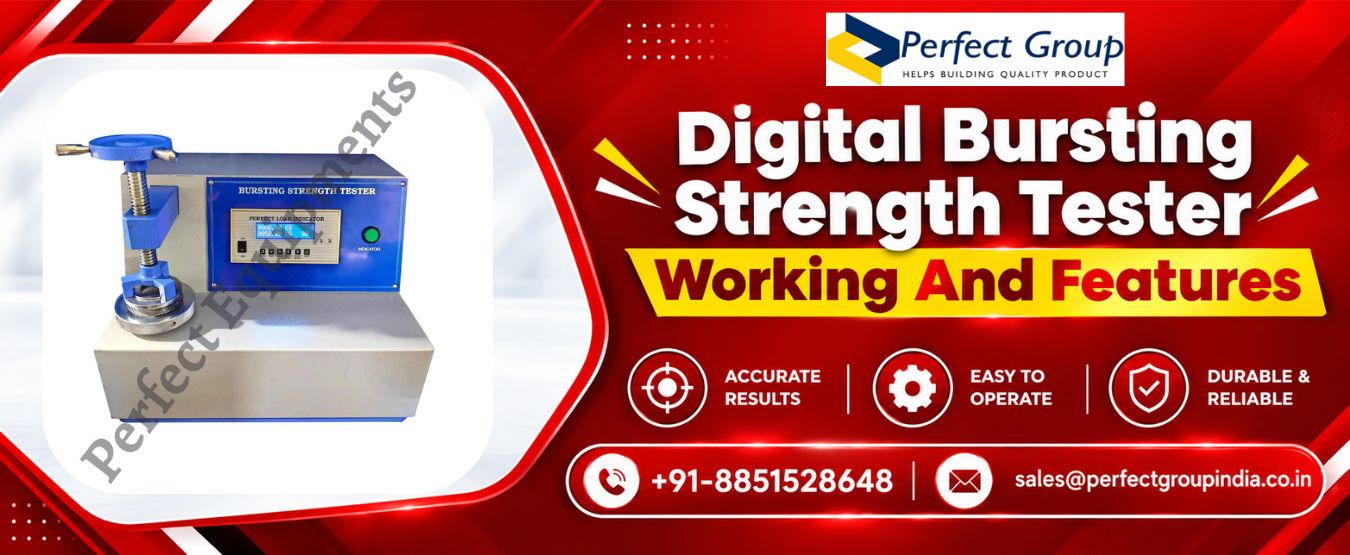
Digital Bursting Strength Tester Working And Features
Introduction
In material testing a Digital Bursting Strength Tester helps find how much hydraulic pressure paper or board can take before it breaks. This test gives a bursting strength value which helps laboratories compare samples and understand how a material can perform under pressure. ISO 2758:2014 covers bursting strength testing for paper from 70 to 1,400 kPa whereas ISO 2759 covers board over a pressure range. This guide explains the working principle, parts, test process, standards, features, results and buying points.
What Is a Digital Bursting Strength Tester?
A Digital Bursting Strength Tester is a laboratory instrument that measures the pressure necessary to burst a prepared material sample. The sample is kept tightly over an opening then hydraulic pressure pushes a diaphragm onto the sample until the material breaks. The maximum pressure at failure appears on the display. This gives the operator a reading of the sample’s strength.
In simple words, the machine answers one useful question: how much pressure can this material take before it bursts?
This information can be useful for paper, paperboard and related testing work depending on the selected test method and instrument design.
How Does a Digital Bursting Strength Tester Work?
The Bursting Strength Tester works by increasing hydraulic pressure below a flexible diaphragm until the test sample breaks. First, the prepared sample is placed over the test opening and secured with a suitable clamping system. Pressure then rises through the testing fluid, causing the diaphragm to expand against the sample until rupture occurs.
The main working steps are:
-
A suitable sample is placed over the testing area.
-
The sample is held tightly so it does not move during testing.
-
Hydraulic pressure goes up at speed.
-
The material breaks when it reaches its strength.
-
The highest pressure is recorded for the report.
After the material breaks, the system can stop the pressure increase and retain the peak reading, depending on the tester design.
What Is the Principle Behind Digital Bursting Strength Testing?
The basic principle is based on applying increasing hydraulic pressure to a material until it bursts. The measured pressure represents the material's bursting strength under the selected test conditions, sample size and test method.
A digital system adds electronic pressure sensing and display functions, so the operator can read the result directly instead of reading an analogue gauge.
For paper testing, ISO 2758 defines bursting strength as the maximum pressure developed when a hydraulic system forces an elastic diaphragm through a circular area of paper.
What Materials Can Be Tested?
The exact material range depends on the tester model and standard selected for the work. Paper is specifically covered by ISO 2758 and boards including corrugated and solid fibreboard are covered by ISO 2759. Textile fabrics use a different method, with ASTM D3786 covering diaphragm bursting strength testing for knitted, nonwoven and woven fabrics.
Common material categories include:
-
Paper: Sheets requiring bursting strength measurement.
-
Paperboard: Board samples tested under suitable pressure ranges.
-
Fibreboard: Solid fibreboard can be tested under the relevant method.
-
Corrugated board: Suitable instruments can test board using the correct standard.
-
Textiles: Certain models are designed for fabric testing under ASTM D3786.
The important point is to select a Digital Bursting Strength Tester according to the material, expected pressure range and standard required for your laboratory.
What Are the Main Features to Look For in a Digital Bursting Strength Tester?
A good Digital Bursting Strength Tester should have features that make pressure reading, sample holding and result recording simple. Current digital models commonly offer digital displays, peak value retention, calibration functions and different measurement units.
Important features include:
-
Digital display: Shows the measured pressure clearly.
-
Peak hold: Keeps the highest pressure reached during the test.
-
Strong clamping: Helps hold the sample securely.
-
Calibration function: Supports adjustment against a suitable reference.
-
Multiple units: Some models show kg/cm², bar, psi, N/cm² and kPa.
-
Microprocessor control: Handles measurement and display functions electronically.
-
Data output: Selected models can transfer results to a computer.
-
Report printing: Some advanced versions include an inbuilt thermal printer.
For example, one current BST-D3 model lists a 50 kg/cm² capacity, 0.1 kg/cm² resolution, colour LCD display and peak hold function.
Which Standards Are Used for Bursting Strength Testing?
The correct standard depends mainly on the material being tested. ISO 2758:2014 is the current ISO method for paper, covering a bursting strength range of 70 to 1,400 kPa. ISO 2759:2014 covers boards including corrugated and solid fibreboard with a specified range from 350 to 5,500 kPa.
For textiles ASTM D3786 covers diaphragm bursting strength testing. Describes hydraulic or pneumatic testing, for textile fabrics. So buyers should not select a machine only because its name contains the word bursting even if it sounds bursting.
They should confirm that the instrument, pressure range, sample setup and test method match their actual testing requirement.
Why Is Bursting Strength Testing Important?
Bursting strength testing gives a numerical way to compare how different material samples respond to increasing pressure. For paper and board manufacturers, this information can support material selection and laboratory quality work when used with the correct test method.
A test result can help teams:
-
Compare different material batches.
-
Study changes in paper strength.
-
Identify weaker samples.
-
Record pressure values for laboratory reports.
-
Support material development decisions.
-
Compare results against a chosen specification.
The value should always be interpreted with the relevant standard because different materials and test methods can produce different results.
How to Choose the Right Digital Bursting Strength Tester?
Choosing the right Digital Bursting Strength Tester depends on your material, pressure range, standard and reporting needs. A paper laboratory can need a different pressure range from a board laboratory, so one machine should not automatically be treated as suitable for every sample.
Before purchasing, consider:
-
Material: Confirm whether you test paper, board, textiles or another approved material.
-
Pressure range: Select a range suitable for your expected bursting values.
-
Standard: Confirm the required ISO, ASTM or applicable Indian method.
-
Resolution: Look at the smallest pressure increment shown by the machine.
-
Clamping: Choose a holder suitable for your sample type.
-
Peak reading: A peak hold function can simplify result recording.
-
Calibration: Ask how calibration is performed and documented.
-
Data handling: Decide whether USB, software or printing is needed.
-
Service: Consider calibration and technical support after purchase.
Perfect Group India provides testing instruments for laboratories and industries and its digital bursting tester offering is positioned for material strength testing.
Conclusion
The Digital Bursting Strength Tester is a tool for laboratories that test paper and board making it simple to measure the pressure needed to burst a sample. It provides a digital reading, a peak value feature and controlled hydraulic testing that make it easier to record and compare results. The important decision however is not simply to buy a machine with a digital display. A Tester must have a pressure range, a proper sample holder, a reliable calibration method and a standard that matches the material being tested. ISO 2758 is the standard for paper ISO 2759 is the standard for board and ASTM D3786 is the standard for textile fabric.
Perfect Group India can be considered with other established testing instrument suppliers after comparing technical specifications and service support. A suitable tester should match the material, method and reporting needs of your laboratory.