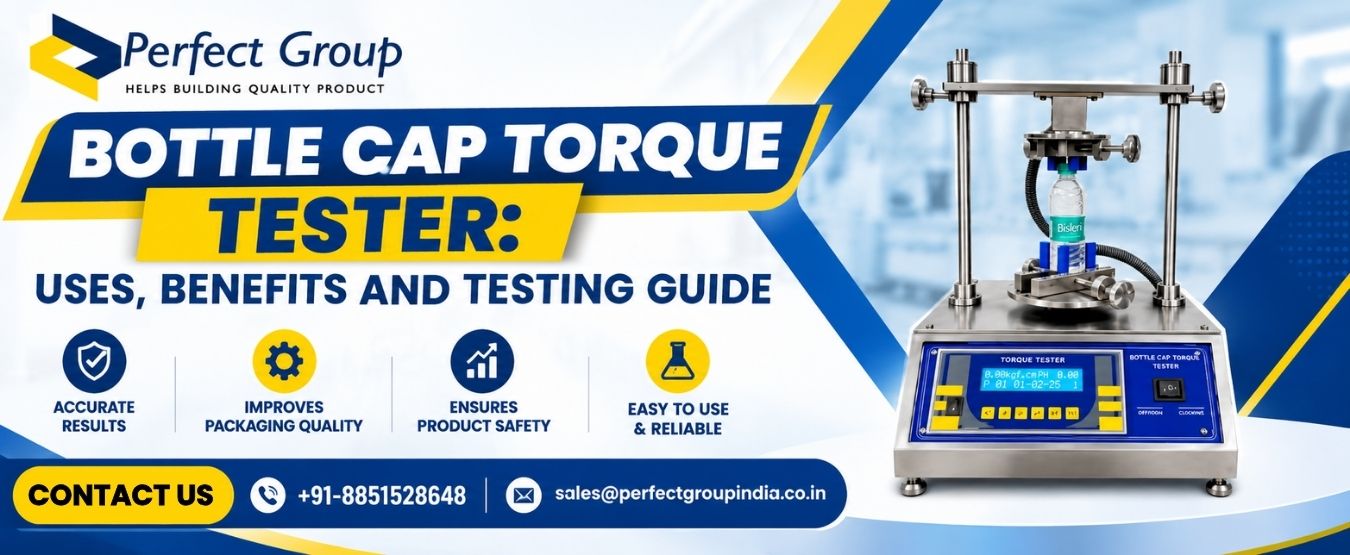
Bottle Cap Torque Tester: Uses, Benefits and Testing Guide
Introduction
In packing work a bottle cap torque tester is used to determine the amount of torque required to open or remove a cap that has been closed. This is an important consideration because a little torque can negatively impact the closure but an excessively large amount of it can require excessive effort to open the package. ASTM D2063/D2063M-24 provides a standard testing method for finding the removal torque of continuous thread closures on containers. This guide explains the basic working of the test, why manufacturers use it, important features of a torque tester, the testing process, related standards and how the results can help the packaging industry.
What Is a Bottle Cap Torque Tester?
The amount of force needed to tighten or loosen a bottle cap is measured by a laboratory instrument called a bottle cap torque tester. The bottle is held firmly, the cap is fixed and the instrument measures the torque because the closure is being turned during the test.
Torque is usually expressed in N·m, depending on the instrument and the test method. Modern equipment offers digital display, data storage, statistical calculation and various clamping arrangements for different bottle and closure sizes.
The main objective is to obtain a quantitative value which would replace the subjective evaluation of the manual test during the process of packaging inspection.
Why Is a Bottle Cap Torque Tester Used?
When manufacturers want a measurable value for cap tightening or removal force, they use a cap torque tester. ASTM specifies that torque retention testing can support packaging development and engineering evaluation for container and continuous thread closure systems.
The test can help packaging teams study whether a closure stays within a selected torque range after filling, storage, transport or controlled conditioning.
Common reasons include:
-
Opening torque: Measures the force needed to remove a fitted cap.
-
Application torque: Records the force used when closing a package.
-
Torque retention: Shows how removal torque changes over time.
-
Process study: Helps compare different closure settings during development.
-
Package evaluation: Provides numerical data for closure performance.
The necessary torque value is decided by the bottle, cap design, material, closure system and packaging requirement rather than a singular value
What Does a Bottle Cap Torque Tester Measure?
The turning force created during closure tightening or cap removal can be measured with a Torque Tester for Bottle Cap. The exact measurement range depends on the instrument, load cell, fixture and design selected for the intended bottle size.
For example, one commercial digital tester lists load cell capacities of 5, 20 and 40 N·m, with different clamping ranges.
Important measurements can include:
-
Removal torque: Force required to loosen the cap.
-
Application torque: Force recorded during cap tightening.
-
Peak torque: Highest torque value recorded during a test.
-
Torque retention: Change in removal torque after a defined period.
-
Repeat readings: Results collected from several samples for comparison.
These values give packaging teams numerical data that can be compared with their selected product specification.
How Does a Bottle Cap Torque Tester Work?
Before applying a regulated rotational force Torque Tester for Bottle Cap typically holds the bottle body and closure firmly. The sensor detects the torque produced during rotation and the instrument displays the measured value for recording.
A typical test can follow these steps:
-
Place the bottle securely inside the fixture.
-
Adjust the holder according to bottle dimensions.
-
Position the cap correctly inside the closure clamp.
-
Set the required testing mode and measurement range.
-
Apply controlled rotation to the closure.
-
Record the displayed torque value.
-
Repeat the test with additional samples.
-
Compare readings with the selected specification.
Automated torque testers can also regulate the applied clamping force and rotational speed during measurement which reduces variance between manual measurements during repeated testing.
What Are the Benefits of Using a Bottle Cap Torque Tester?
Instead of depending only on physical handling, packaging teams can review closure performance on a numerical basis with a bottle cap torque tester. This can make product development easier because different caps, bottles, tightening settings and storage conditions can be compared using recorded torque values.
Key benefits include:
-
Measured results: Provides numerical torque readings for packaging studies.
-
Repeat testing: Allows several samples to be tested under similar conditions.
-
Better development: Helps compare closure designs during product development.
-
Opening study: Shows whether removal torque changes across samples.
-
Data recording: Digital models can support stored readings and statistical analysis.
-
Process control: Recorded values can help review cap tightening settings.
The benefit is greatest when the selected tester has a suitable capacity and fixture for the package being studied.
What Features Should You Look for in a Bottle Cap Torque Tester?
The bottle size, the cap size, torque range and the needed testing technique should be considered while selecting a bottle cap torque tester. Choosing equipment only from its appearance or maximum capacity can not provide suitable readings for smaller torque values.
Important features include:
-
Torque range: Should suit the expected measurement values.
-
Accuracy: Look for specified accuracy across the required measurement range.
-
Resolution: A finer display can help record small torque changes.
-
Bottle clamp: Should hold the container firmly during rotation.
-
Cap clamp: Should grip the closure without unwanted slipping.
-
Data output: USB or printer options can support result records.
-
Testing modes: Manual or automatic operation can suit different laboratories.
-
Calibration support: Equipment should allow suitable calibration procedures.
ASTM D3474-23 is specifically listed for calibration and use of torque meters in packaging work.
Which Standards Are Used for Bottle Cap Torque Testing?
Depending on the closure type and the test's goal, a bottle cap torque tester can be applied together with accepted methods. ASTM D2063/D2063M-24 covers quantitative measurement of removal torque for continuous thread closures on containers with matching finishes.
Another ASTM listing, D7860, covers torque retention measurement for child resistant and non child resistant packages using automated torque equipment.
Before testing, the laboratory should identify the current standard, sample type, conditioning requirements, torque direction and reporting method required for its study.
What Should You Avoid During Torque Testing?
Improper clamping of the item or the use of incorrect accessories can impact on the measured value and make the results harder to compare. Stability of the bottle, correct seating of the cap and operation within the specified measuring range of the instrument are critical.
Avoid these common issues:
-
Using a torque range that is unsuitable for the sample.
-
Allowing the bottle to rotate during testing.
-
Holding the cap unevenly inside the fixture.
-
Mixing different testing conditions without recording them.
-
Ignoring calibration requirements.
-
Comparing results produced using different test methods without proper context.
How Can You Choose the Right Bottle Cap Torque Tester?
In contrast to a generic category of products torque tester should be specifically selected according to the actual packaging. Start by identifying the expected torque range, bottle diameter, cap diameter, sample height, test direction and required testing frequency.
Perfect Group India can be considered when sourcing packaging testing equipment, but the final model should be selected from its published technical specifications.
For a practical selection, compare:
-
Required torque range.
-
Expected accuracy and resolution.
-
Bottle and cap dimensions.
-
Manual or automatic operation.
-
Data storage and export options.
-
Calibration requirements.
-
Fixture design and sample holding method.
-
Laboratory space and testing volume.
Conclusion
For packaging laboratories a bottle cap torque tester provides valuable numerical information on the force required to tighten or loosen bottle closures. Its value comes from controlled measurement, suitable fixtures, proper calibration and a test method that matches the closure being studied. ASTM D2063/D2063M-24 offers a standard test method for the removal torque of continuous thread closures, providing laboratories with an invaluable reference for a suitable testing procedure. The right kind of tester should fit the size of the package, range of torques, measurement needs and laboratory procedures. Perfect Group India can be explored for laboratory equipment for packaging testing.