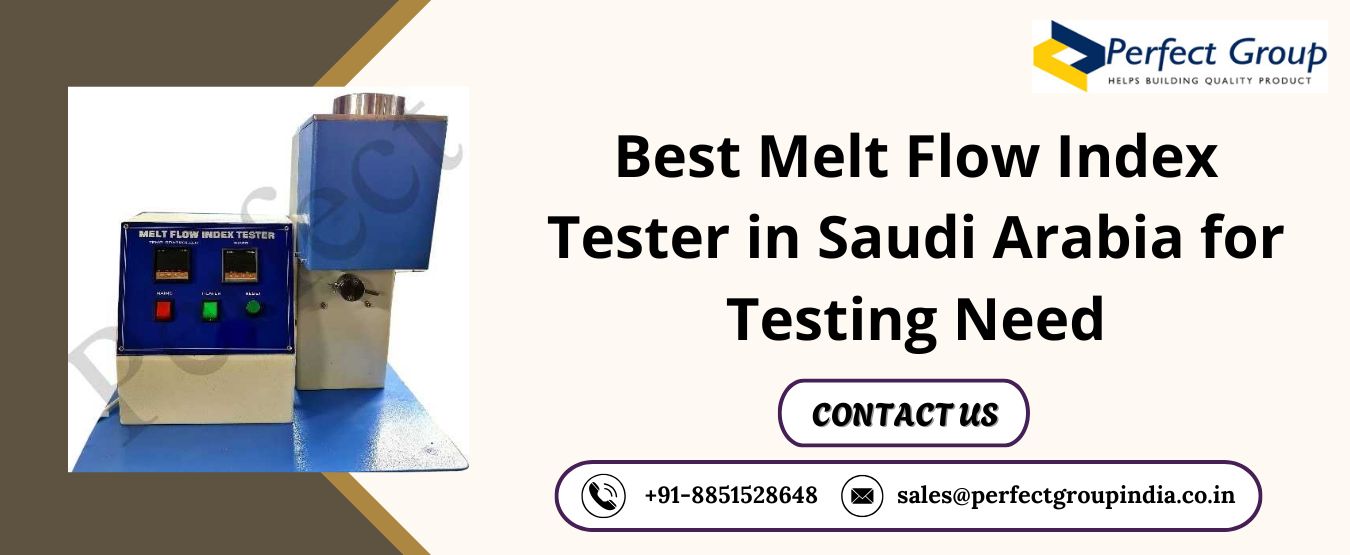
Best Melt Flow Index Tester in Saudi Arabia for Testing Need
Introduction
The flow behaviour of thermoplastic polymers under specific load and temperature conditions is measured using a Melt Flow Index Tester in Saudi Arabia. The result helps in measuring material quality and processing behaviour for plastic manufacturers, recyclers, machines and labs. Temperature stability, test load flexibility, accuracy, accuracy, relevant standards, hygiene and support services are all key factors to consider when choosing equipment for Saudi Arabian industry. Before material change has an impact on extrusion, injection moulding, recycling or the quality of the final product, proper melt flow testing can detect it.
What Is a Melt Flow Index Tester in Saudi Arabia?
A Melt Flow Index Tester in Saudi Arabia is laboratory equipment that measures both the Melt Flow Rate (MFR) and, if supported, the Melt Volume Rate (MVR) of thermoplastic materials. Polymer is heated inside a controlled barrel and pushed out through a specific die under a set load. The results show useful information about melt viscosity and flow properties.
Why Is Melt Flow Testing Important for Plastic Manufacturers in Saudi Arabia?
testing is a useful quality control check point between raw materials, processing and finished products. It helps in identifying batch differences, verifying incoming polymers, analysing recycled materials, and guaranteeing uniform extrusion or injection moulding.
Best Uses of Melt Flow Index Tester in Saudi Arabia
- Incoming raw-material inspection: Manufacturing guarantees that the supplied polymer behaves continuously with the specified parameters.
- Recycled plastic testing: Can change if recycled material is changed. Regular testing helps in detecting abnormal or incorrect material.
- Polymer screening: Known polymer grades under the same conditions, MFR results offer a helpful screening measure.
- Material consistency: Repeated results from controlled samples help quality teams monitor production stability.
- Batch difference detection: batches could point out differences in material, degradation, pollution, or processing history.
- Pre-platting control: Testing before or during pellet production can help recyclers identify if the process is creating similar material.
- Recycled granule verification: Finished recycled granules can be tested before shipment to confirm requirements with internal or customer specifications.
- Extrusion optimization: Melt flow behavior can support decisions about material suitability for extrusion, although it should not replace process specific testing.
- Injection moulding selection: MFR data helps processors compare materials for use that require specific flow behavior.
- Production troubleshooting: Unexpected changes in flow can provide an early indication of material or processing problems.
- Supplier verification: Buyers can compare received polymer against agreed technical specifications using controlled test conditions.
- Customer specifications: Consistent MFR reporting supports documentation and quality verification when customers specify particular material characteristics.
What Does a Melt Flow Index Tester in Saudi Arabia Measure?
The instrument measures MFR, which is commonly defined as the volume of polymer flowing through the die over a specified time period is measured by Melt Flow Index Tester in Saudi Arabia. Some systems also calculate MVR, which represents extruded volume over time. The results are affected by the polymer type, test temperature, applied load, conditioning, die dimensions and testing standard. As a result, there is no single temperature or load that is suitable for all polymers.
How Is a Melt Flow Index Tester Used in Plastic Recycling?
Recycling facilities can test incoming raw materials, supplies and final granules. Testing regularity should be set by material variations, polymer type, recycled content, supplier consistency, production volume, customer specifications and process sensitivity. A written quality control plan is more dependable than random testing.
Common Testing Mistakes to Avoid
-
Incorrect temperature or test load
-
Poor sample preparation or conditioning
-
Contaminated or blocked die
-
Inadequate instrument cleaning
-
Skipping calibration
-
Comparing results from different test conditions
-
Ignoring batch variation
-
Failing to record test conditions
What Features Should You Compare Before Buying a Melt Flow Index Tester?
Give priority to temperature stability, accuracy, reliability, test-load flexibility, proper standards, a digital display, cleaning accessibility, build quality, testing / calibration support, maintenance needs, service availability and spare parts availability. High volume industrial laboratories might focus on stability and workflow effectiveness, whereas research laboratories might require greater testing flexibility.
Practical Buying Recommendation
Before purchasing a Melt Flow Index Tester in Saudi Arabia, identify:
-
Polymers to be tested
-
Required testing standards
-
Temperature and load combinations
-
Testing frequency
-
Required automation
-
Calibration and service needs
Conclusion
The most suitable Melt Flow Index Tester in Saudi Arabia should be compatible with the polymer, suitable standard, temperature and load specifications, accuracy, repeatability, testing requirements and laboratory workload. Plastic manufacturers, recyclers, processors and laboratories must think about the whole testing workflow before choosing equipment based just on pricing. Perfect Group India should be checked with these technical requirements when analysing melt flow testing equipment for professional polymer quality control.